Category: English

  • What a 46,057-impression post taught me about marketing

    What a 46,057-impression post taught me about marketing

    Storytelling marketing: a practical guide from Nplay. This article covers what matters about storytelling marketing, from the first idea to delivery.

    Storytelling marketing beat years of advice posts for me in a single afternoon. My posts average about 500 impressions. One of them reached 46,057. Same account, same connections, nothing different about the day — except that I told a story instead of giving advice. Here are the numbers, the story, and the seven things I took from it that now shape how we do marketing for our clients.

    What a 46,057-impression post taught me about marketing

    Ninety times my average, from two minutes of typing

    I post on LinkedIn regularly and my posts get, on average, around 500 impressions. That is my normal. Then one post did 46,057. I did not boost it, I did not tag anyone, I did not post at a magic hour. I wrote it in under two minutes, on my phone, still slightly annoyed.

    When I opened the analytics I found the interesting part. Only 6 per cent of the people who saw it were in my network. The other 94 per cent were strangers — the platform pushed the post to more than 30,000 members I had never interacted with. It produced 191 profile views and 12 new followers, from a post that contained no advice, no tip and no lesson. Just what happened at the airport.

    I have spent years writing careful posts with useful frameworks and neat conclusions, and none of them came within a tenth of this. So I did what anyone in marketing should do when reality embarrasses their theory: I looked at what the outlier had that the others did not. Below is the story, and then the seven things I took from it. Some of them are about LinkedIn. Most of them are about how brands talk to people.

    The story: a passport with five months and twenty-nine days

    It was a one-day work trip to Cairo, and Murphy’s law arrived early. Online check-in was down. The self-service kiosks were down. So I queued at the counter, where the agent looked at my passport and told me it had less than six months of validity — five months and twenty-nine days — and that I would have to renew it before flying.

    I went to the passport office inside the airport. The officer there told me the opposite: it is valid, you are fine by two days, go and fly, and do not renew here because renewing at the airport costs double when the passport still has more than six months. Two counters, thirty metres apart, two confident and opposite answers.

    Back at check-in, I opened an AI assistant on my phone and had it count the days precisely, then showed the agent the screen. She mocked the AI. Not the calculation — the idea that I would trust a chatbot over her. The clock was running and the plane was not going to wait for us to settle the philosophy of machine intelligence, so I agreed to whatever was needed and caught the flight.

    That is the whole post. No moral. I did not win the argument. Nobody learned anything except that airports are airports. And 46,000 people read it.

    Tell what happened, let someone else be the character, keep the lesson inside

    1. Tell something that actually happened, not something you know. The feed is full of people explaining things. It is not full of people who were at a counter at six in the morning being told two opposite facts. People are exhausted by advice. They have never once been exhausted by a story. Every piece of brand content we now produce at Nplay starts with the question “what actually happened?” before “what do we want to say?”.

    2. You do not have to be the hero. The check-in agent made that post, not me. She had the best line — mocking the AI — and I was just the person standing there with a phone. When a company tells a story, it almost always casts itself as the hero, and that is exactly the moment the audience stops believing. Let the customer, the technician or the visitor be the character. The brand can hold the camera.

    3. Keep the lesson inside the story and in the comments. I did not explain what the story meant. The comments did, in about twenty different directions, and every one of those comments carried the post to a new group of people. When you hand people the analysis, you close the conversation. When you leave space, they open it for you.

    Do not preach like Aristotle, and let the ending be true

    4. Do not preach. There is a temptation, particularly for those of us who run companies, to end every story with “and the moral is…”. Aristotle could get away with it. On a phone screen it reads as a lecture, and people leave lectures. If the story is good, the moral is already in the room. If the story is weak, the moral will not save it.

    5. The ending should be true, not heroic. I gave in. I agreed to whatever the agent wanted and I caught my flight. I did not produce a devastating argument, the airport did not change its policy, and I did not fly home with a lesson for humanity. That ending is the reason the post worked. People recognised it because it is how their own mornings end.

    Compare that with the average brand case study, where every project finishes with a smiling client and a percentage. We write case studies too — see the memorial hologram project — and the ones people actually read are the ones that admit the dome projectors that had to be taken down and relocated, the content that went through several review rounds with the client, the cabling routes nobody had drawn before our technicians surveyed them. True endings are more persuasive than triumphant ones because they are the only kind the reader has ever lived through.

    Shoot with your phone — and admit you do not fully know why it worked

    6. Shoot with your phone. The feed is now wall-to-wall AI-generated images and polished designs, every one of them perfect and every one of them identical. An ordinary photo, slightly crooked, taken by a tired man at a counter, is what stops the thumb. This sounds like a LinkedIn tip but it is actually a brand tip. We run a 3D content studio and we make holograms for a living, so believe me when I say that polish has a place — on the exhibition stand, in the product film. In the feed, the honest phone photo of the hologram being unloaded from the van beats the render of the hologram every single time.

    7. Maybe a keyword got lucky. I am not a growth expert and I do not pretend to understand the algorithm. It is entirely possible that some accidental word in the post — “AI”, “passport”, “Cairo” — matched something the platform wanted to promote that week. I am not going to build a theory on one data point. These are simply the numbers that were in front of me, and I would rather show you the numbers than sell you a formula.

    The post by the numbers

    One post, one afternoon

    46,057Impressions, against a personal average of about 500LinkedIn analytics, Hani Alhaj’s account
    94%Of viewers were outside my network; only 6% were connectionsLinkedIn analytics
    30,000+Members the platform pushed the post to on its ownLinkedIn analytics
    191Profile views and 12 new followers, from under two minutes of writingLinkedIn analytics

    What this means when the storyteller is a company

    I run a company that sells immersive technology, so I have a stake in the answer to an obvious question: does any of this apply when the author is a brand rather than a slightly annoyed man at an airport? I think it applies more, not less, because brands start from a deficit of trust.

    Here is how it has changed our own work. When we plan content for a client through our marketing services, we now ask for incidents before we ask for messages. What happened at the last exhibition? Which visitor asked the AI avatar a question nobody expected? Which screen went dark ten minutes before the opening and how did the technician fix it? Those are the posts. The message hides inside them.

    It has also changed how we think about the physical experiences we build. A hologram on a stand is not just a display; it is an incident. Visitors photograph it on their own phones, badly lit, and tell the story to people who were not there. That is a 94-per-cent-outside-your-network moment, generated by the stand rather than by the marketing department. We design for it deliberately now: something on the stand should be worth telling someone about at dinner.

    And we try not to be the hero. The visitor is the hero. The technician is the hero. We hold the camera.

    A one-week challenge

    I ended the original post with a challenge and I will end this one the same way. For one week, write only about situations that actually happened to you. No advice at the end. No “here is what I learned”. No framework. A photo from your phone if there is one. Then tell me what happened to your numbers.

    If you are a brand, do the same with your company page: one week of incidents instead of announcements. If it goes badly, you have lost a week. If it goes the way mine did, you will have learned more about your audience than a year of careful posting taught me.

    And if your incident happened in front of a hologram, a video wall or a virtual exhibition stand we built, send it to us. We collect them.

    FAQ

    Storytelling marketing: frequently asked questions

    Did you change anything about the account or the timing?

    Nothing. Same account, same connections, an ordinary weekday. The only difference was the content: an account of something that happened, with no advice attached.

    Should companies really post unpolished phone photos?

    In the feed, yes — an honest photo stops people in a stream of perfect renders. Polish belongs where the audience has chosen to look closely: the exhibition stand, the product film, the hologram content. Match the finish to the setting.

    How does this apply to Nplay’s marketing work for clients?

    We start content planning with incidents rather than messages, we let the customer or technician be the character, and we design physical experiences — holograms, screens, virtual booths — so that visitors have something worth retelling. See our marketing and creative services for how that is packaged.

    Was it just the algorithm?

    Possibly, in part. I am not a growth expert and I will not build a theory on one post. But 94 per cent of viewers being strangers is consistent with a story being shared and commented on rather than merely seen.

    Further reading: Extended reality (Wikipedia)

    Quick questions about storytelling marketing

    Who is storytelling marketing for? Companies and institutions that want a clearer, faster experience for their customers and visitors.

    How long does storytelling marketing take? It depends on the size of the project and the content needed. We confirm the timeline after a short discovery call.

    How do I start with storytelling marketing? Contact the Nplay team in Amman or Riyadh and we will suggest a clear first step.

    Does storytelling marketing work in Arabic and English? Yes. We prepare the content in both languages from day one.

    In short, storytelling marketing works best when it starts from a clear goal. Nplay plans storytelling marketing around your audience, your space and your budget. If you are comparing options for storytelling marketing, ask for a live demo before you decide. We are happy to answer any question about storytelling marketing.
  • How student-generated 3d content grows a university library

    How student-generated 3d content grows a university library

    Student-generated 3d content: a practical guide from Nplay. This article covers what matters about student-generated 3d content, from the first idea to delivery.

    A university can buy a 3D teaching library, or it can grow one. MIHWAR (محور), the working prototype built by Nplay for Interactive Solutions, Amman, and prepared for a Jordanian university, takes the second route: students build models, an academic reviews them, and the approved asset joins a library the university owns. This post explains how coursework can feed that library, why the cost per module falls each year, what could go wrong, and why the student marketplace is a proposal for the legal office and nothing more.

    How student-generated 3d content grows a university library

    A library that grows by coursework, not by purchase order

    Most universities that want 3D and XR content for teaching end up renting it. A global XR content library sold per seat arrives ready-made, but the university pays again every year, cannot reshape the content and does not keep it when the contract ends.

    MIHWAR starts from the opposite premise. Its tagline is “the 3D and XR teaching platform the university owns”. It is a library of interactive 3D models and 360° captures that the university’s own students and faculty build, review and keep, replacing a per-seat subscription to somebody else’s content library. Eleven colleges share one core.

    The engine of that library is student-generated 3d content. The student home screen, seen in the prototype through a third-year applied medical sciences student, lists tasks set by instructors, and one of them is to contribute a model to the library. Work that would otherwise be marked and forgotten gets a destination: it is submitted, reviewed and published as a teaching asset. That is a design for the library, not a claim about results: MIHWAR is a prototype.

    How it works

    From coursework to library asset

    1. An instructor sets the task

      The student home screen lists tasks set by instructors, such as contributing a model or building an experience from three library models.

    2. The student builds and uploads

      The student uploads the model and declares its licence. The library keeps it as glTF, with a named owner.

    3. An academic reviews it

      The submission waits in the review queue. An academic in the owning college decides whether it is fit for students.

    4. It becomes a shared asset

      On approval the model is published. Every instructor in the university can teach from it, alone or inside a scene or a 360° capture.

    Production routes

    Four ways content enters, one review gate

    RouteWho produces itWhat it addsPasses the academic review gate
    Student courseworkStudents, on tasks set by instructorsModels and experiences that grow the library as a by-product of teachingYes
    Campus captureLecturers with a consumer 360° cameraPlaces such as a ward, a hangar or a dig site, with teaching hotspotsYes
    AI-assisted generationStaff who describe what they need to teachA draft model in under a minute, which a human then judgesYes
    Commissioned modellingSpecialists briefed by the universitySpecialist models where a module needs themYes

    Why cost per module falls each year

    A per-seat subscription is a recurring cost. The invoice returns every year, and the content it buys stays on the supplier’s side of the contract.

    A library that grows by coursework behaves differently. Each approved model is made once, in the course of normal teaching, and then reused by every module that needs it. Next year’s students add to the stock rather than replace it. The library grows by coursework rather than by purchase order, so cost per module falls each year instead of recurring.

    We are not publishing figures. MIHWAR has no deployment to measure, and any number would be invented. The argument is structural: one cost recurs, the other is spread across a growing set of reusable assets. Student coursework is one route of four. We cover the AI route in our post on AI generation and the review gate and the capture route in our post on 360° captures.

    Planning target

    Coverage, not asset count

    What matters is how many assets map to the university’s own course modules, carry a defensible licence and were checked by an academic in the owning college.

    ~660assets: the planning target, described as covering every practical module in eleven collegesMIHWAR prototype planning target
    11colleges sharing one coreMIHWAR prototype
    4production routes, all through the same academic review gateMIHWAR prototype

    Declared licence, named owner, open format

    A review gate only works if every asset says what it is and who stands behind it. In MIHWAR every model, scene and 360° capture carries a declared licence and a named owner. That includes work submitted by students.

    Storage matters as much as the label. Assets are kept as glTF in the university’s own storage, so they stay readable and exportable, and still work the day any supplier contract ends. The same scene then runs four ways: in a browser with no install, in a headset over WebXR, on a phone in AR from the same URL, and inside Unity or Unreal as glTF plus a scene manifest. Our post on one scene, four ways out covers that, and owning a library versus renting per seat makes the case against subscriptions.

    A published asset is more than a file. Each model also carries teaching content: what it teaches, its intended learning outcomes and its key features, each with a note. The prototype’s example is a high-bypass turbofan sectioned to show the gas path. Run the animation and the fan, compressor and turbine turn on one shaft.

    Who owns what a student builds is a question for the university, not for us. MIHWAR gives every asset a place to record the answer. The policy itself belongs to the university’s legal office.

    The student marketplace: a proposal, not a promise

    The prototype includes a Marketplace screen built around a proposed idea: students could earn from models they contribute. We present it as a proposal for the university’s legal office only. It touches intellectual property, student contracts and tax, and we expect it to change in review.

    That means three things. It is not a feature the university has adopted. It promises no earnings to any student. And student-generated 3d content reaches the library through the review gate whether or not a marketplace ever exists, because the coursework route described above does not depend on it.

    Risks

    What can go wrong, and how it is handled

    RiskWhy it mattersHow it is handled
    Uneven qualityStudent models vary, and a weak model teaches badlyAn academic in the owning college reviews it before publication, so nothing reaches the library unreviewed
    Unclear IPA model built on someone else’s work exposes the universityThe licence declaration is part of the gate, and every asset carries a declared licence and a named owner
    AI drafts that look finishedA generated model can look plausible and still be wrongDrafts enter the same queue, and a human decides whether they are fit for students
    A library too big to useMany assets, few that match a courseThe measure is coverage of course modules, checked by an academic in the owning college, not asset count
    Supplier lock-inContent trapped on someone else’s platformglTF in the university’s own storage, readable and exportable

    A working prototype, with honest limits

    MIHWAR is a working prototype built by Nplay for Interactive Solutions, Amman, and prepared for a Jordanian university. It is not a mock-up and not a video: models are real geometry rendered in the browser, the level builder composes scenes, the review queue publishes and the export writes files. We claim no deployment, contract, users or results.

    The limits are plain. The 3D models are indicative rather than teaching-grade, the 360° captures are painted rather than photographed, and four stages of the ingest pipeline are represented rather than executed. Nothing needs an install, plugin or network connection to try it, and a guided tutorial of 22 stops takes about six minutes across three roles: student, instructor and university.

    Try the MIHWAR prototype and see where student-generated 3d content would enter. For related work, see our 3D content studio and Nplay Scholar, a concept for 3D interactive training.

    FAQ

    Student-generated 3D content: frequently asked questions

    Can a student really add a model to the library?

    In the prototype, yes. A student uploads a model, it enters the review queue, and an academic decides whether it is published. Nothing reaches the library without that review.

    Who owns a model a student builds?

    Every asset carries a declared licence and a named owner. What that licence says for student work is a policy decision for the university and its legal office. MIHWAR records the answer and does not decide it.

    Will students be paid for their models?

    We promise no earnings. The marketplace is a proposal for the university’s legal office, it touches IP, student contracts and tax, and we expect it to change in review.

    Is MIHWAR in use at a university?

    No. It is a working prototype built by Nplay and prepared for a Jordanian university. It is not deployed, and you can try it directly in your browser.

    Further reading: Extended reality (Wikipedia)

    Quick questions about student-generated 3d content

    Who is student-generated 3d content for? Companies and institutions that want a clearer, faster experience for their customers and visitors.

    How long does student-generated 3d content take? It depends on the size of the project and the content needed. We confirm the timeline after a short discovery call.

    How do I start with student-generated 3d content? Contact the Nplay team in Amman or Riyadh and we will suggest a clear first step.

    Does student-generated 3d content work in Arabic and English? Yes. We prepare the content in both languages from day one.

    3D virtual tours for properties and showrooms by Nplay
    3D virtual tours for properties and showrooms by Nplay
    3D real estate model by Nplay
    3D real estate model by Nplay
    3D city model digital twin by Nplay
    3D city model digital twin by Nplay
  • Why companies happily pay for billboards and flinch at software

    Why companies happily pay for billboards and flinch at software

    Measurable marketing channels: a practical guide from Nplay. This article covers what matters about measurable marketing channels, from the first idea to delivery.

    Measurable marketing channels should win budget, yet billboards still get approved faster than software. Exhibition season is here again, and with it a pattern I have watched for years: companies that will sign for a stand, a billboard and a radio spot without blinking, then agonise for months over a software subscription that costs a fraction of it. This is my attempt to understand why — and to describe the measurable middle path we have ended up building at Nplay.

    Why companies happily pay for billboards and flinch at software

    The stand, the billboard and the flinch

    Every autumn the exhibition calendar fills up, and every autumn I watch the same thing happen. Large companies spend fortunes on exhibitions, on participations, on travel for the team, on the stand itself and on the dozen giant expenses that come with it. They spend on digital out-of-home, on billboards, on radio, even on television. All the tangible things.

    Then the conversation turns to digital marketing, to software, to anything you cannot hold in your hand — and the same companies hesitate over amounts that are a fraction of what they just approved for the stand. The budget is not the problem. Something else is.

    I have asked myself an honest question about my own behaviour here. When I see my company’s advert printed on a board that I drive past every morning, does that mean I did not waste the money? Or does it just mean that I, personally, saw it every day? The advert did not become effective because it became visible to me. But it certainly became easier to defend.

    That is the first clue. A billboard is a receipt you can photograph. A software subscription is an invoice you have to trust.

    When the manager becomes the marketing department

    The second thing I keep noticing is how many managers interfere in marketing decisions — in companies that have a marketing department, and even more so in companies that do not. The interference follows a script. “This brings image.” “This brings brand strength.” “This one brings awareness.” “This is good, this is bad.”

    None of it is based on facts. It is based on what a friend said at dinner, on something heard second-hand, on personal taste. Almost never on KPIs, and almost never on a tool that measures what each channel actually produced. The manager is not being malicious. He simply has opinions about the tangible things because he can see them, and no opinions about the intangible things because nobody has shown him a number.

    So I am left with two questions I do not fully know how to answer. What drives companies to gamble so generously on the tangible and to neglect experimentation in media, settling for the least effort? And what drives managers to step into marketing at all — if a marketing department even exists?

    I posted both questions during a large technology exhibition in Riyadh this month. The replies were mostly stories of the same thing happening somewhere else.

    The bottom-of-the-tank trend

    There is a related habit I want to name, because it comes from the same place. When a company finally does spend on digital, the instruction is often “ride the trend”. Whatever is loud this week, copy it. Whatever the audience is laughing at, laugh with it, even if it is beneath the brand.

    Must marketing descend to the lowest level of its audience and chase every trend regardless of standard? For me, no. A brand that has spent twenty years building a reputation should not spend it in a fortnight for a spike in views that nobody will remember by Ramadan.

    The interesting thing is that “ride the trend” is also a symptom of not measuring. If you cannot tell which content produced enquiries, the only signal left is applause, and applause rewards the loudest thing in the room. Once a team can see which message produced which result, the trend loses its grip very quickly. Our creative and branding team spends a surprising amount of time arguing clients out of the bottom of the tank — and the argument always works better with a dashboard than with taste.

    Why touch feels like proof

    Here is my working theory, offered without a study to back it. A physical channel satisfies three needs at once. It is visible to the manager, so he feels he is getting something. It is visible to the manager’s manager, so the decision is easy to defend. And it is visible to competitors, which feels like winning.

    Software satisfies none of those needs on the day you sign. It sits in a browser tab. It produces its value over months, and the value arrives as a report rather than as a sensation. Everything about the human brain says “that is the risky one”, even when the billboard is the bigger gamble by a factor of ten.

    The digital channels also carry a burden the physical ones never had to carry: they can be measured, so they are asked to prove themselves. Nobody has ever asked a billboard to show its conversion rate. The channel that offers evidence is punished for offering it, and the channel that offers a photograph is rewarded for the photograph.

    I do not think this is fixed by lecturing managers. I think it is fixed by giving them channels that are physical enough to photograph and digital enough to report.

    Compare

    What each channel can actually tell you afterwards

    ChannelWhat can be measuredWhat you are usually told instead
    Static billboardEstimated traffic past the site; little else“Everyone saw it.”
    Radio spotStation reach estimates by time slot“My cousin heard it on the way to work.”
    Exhibition standBadge scans, meetings booked, leads qualified — if someone counts“The stand was busy all day.”
    Cloud digital signage (Nplay Beam)Proof of playback per screen and per slot, uptime, schedule reports, which campaign ran where and when“The screens are on.”
    Hologram display on a stand (Nplay Halo Box)Interactions on the touch layer, questions asked to the avatar, how long people stop in front of it“People stopped to take photos.”
    Hologram ad network (Nplay Halo Ads)Spot delivery per location, per 10-second slot, per campaign, across the network“It looked amazing in the mall.”

    Holograms and signage: physical enough to photograph, digital enough to report

    This is, honestly, how Nplay ended up where it is. We did not set out to solve a psychology problem. We set out to put holograms on exhibition stands and screens in shops, and we noticed that the clients who flinched at software did not flinch at a Halo Box. It is a two-metre cabinet. The chairman can stand next to it. It photographs beautifully. It is as tangible as any billboard.

    But behind the glass it is software. The content is scheduled from Nplay Beam, the same cloud signage platform that runs screens in a national hypermarket chain across 32 branches and in a specialist clinic hub in Amman. Every screen reports what it played and when. Nothing is left to “I think people saw it”.

    The Halo Ads network takes the same idea into malls and transit spaces: an advertiser buys holographic spots the way they buy digital inventory, by the ten-second slot, with delivery reported per location. The manager gets his photograph. The marketing team gets its numbers. For once, both sides of the table leave the meeting satisfied.

    I have started calling this the middle path, because it does not ask a company to abandon the tangible. It asks the tangible to start reporting.

    Three questions I would ask before signing anything

    If you are approving a marketing spend this season — a stand, a screen, a campaign, a subscription — here are the three questions I have learned to ask, in order.

    • What will this channel report to me next month? Not what it will “bring”. What it will show. If the honest answer is “nothing”, price that in.
    • Who decided this, and on what basis? If the basis is a friend’s opinion, the decision deserves the same weight as the friend’s opinion.
    • What is the experiment budget? Not the campaign budget — the small amount set aside to test two channels against each other and let the numbers decide the following year.

    None of this is new. Every marketing textbook says it. What is new, at least in our market, is that the tools to answer the questions are now cheaper than the stand — and available in Arabic, from a team in Amman and Riyadh that can also build the stand. You can read how we approach it on our marketing services page, or see what a hologram campaign costs in our MENA cost guide.

    I still do not have the full answer to my two questions. If you have one, I would like to hear it.

    FAQ

    Questions people asked after the post

    Are you saying billboards and exhibitions are a waste of money?

    No. They reach people, and a stand is often the only place a whole industry meets in one week. The point is that they are usually approved without evidence and never asked for any, while cheaper digital channels are asked to prove themselves before they start. Treat both to the same standard.

    How does Nplay measure a hologram campaign at an exhibition?

    The Halo Box runs on our cloud platform, so we know exactly what content played and when. Where the interactive layer is used, we also see what visitors touched and which questions they asked the AI avatar. Combined with the stand’s own lead count, that gives a far clearer picture than foot traffic alone.

    What can Nplay Beam report for a screen network?

    Proof of playback per screen and time slot, device uptime, schedule and campaign reports, and centralised control of users, devices and media — from one dashboard covering one screen or hundreds across branches.

    Does measuring everything mean chasing every trend?

    The opposite. When you can see which message produced which result, loud trends lose their appeal quickly, because most of them produce views and nothing else. Measurement is what lets a brand keep its standards and still perform.

    Further reading: Extended reality (Wikipedia)

    Quick questions about measurable marketing channels

    Who is measurable marketing channels for? Companies and institutions that want a clearer, faster experience for their customers and visitors.

    How long does measurable marketing channels take? It depends on the size of the project and the content needed. We confirm the timeline after a short discovery call.

    How do I start with measurable marketing channels? Contact the Nplay team in Amman or Riyadh and we will suggest a clear first step.

    Does measurable marketing channels work in Arabic and English? Yes. We prepare the content in both languages from day one.

    In short, measurable marketing channels works best when it starts from a clear goal. Nplay plans measurable marketing channels around your audience, your space and your budget. If you are comparing options for measurable marketing channels, ask for a live demo before you decide. We are happy to answer any question about measurable marketing channels.

  • A 3d content library for universities should be owned, not rented

    A 3d content library for universities should be owned, not rented

    3d content library for universities: a practical guide from Nplay. This article covers what matters about 3d content library for universities, from the first idea to delivery.

    A university that rents its 3D teaching content pays for access every year, and the library leaves with the contract. The alternative is to own it: every model carries a declared licence, every asset has a named owner, and everything is stored as glTF in the university’s own storage. This post sets out what that ownership means in practice, why coverage matters more than asset count, and what to ask any supplier. We built the MIHWAR prototype to show the approach working.

    A 3d content library for universities should be owned, not rented

    Renting access or owning a library

    When a university buys content in the usual way, it buys a subscription: a number of seats, a catalogue chosen by the supplier and a renewal date. That is easy to start. It also means the university’s teaching depends on content that sits on somebody else’s platform, in somebody else’s format, under terms the university did not write.

    The alternative is to treat 3D teaching content as the university treats a textbook its staff wrote or a laboratory it built: as an academic asset. Someone in the owning college checked it, someone is named as responsible for it, and it can be used, changed and kept without asking permission.

    This is not a claim that a global XR content library sold per seat is wrong for every institution. It can be a sensible way to start. The question here is narrower: what should a university be able to say it holds once the contract is signed, and what happens to its teaching on the day that contract ends? For a 3d content library for universities, that question matters more than the size of the catalogue.

    What ownership concretely means

    “Ownership” is easy to claim and hard to test, so we reduce it to four checks. If one fails, the university is renting.

    • A declared licence. Every model, scene and 360° capture states the licence it is held under, so staff can see for each asset what they may do with it.
    • A named owner. Every asset has a person or college accountable for it. A lecturer knows who to ask about an error, and a dean knows who approved it.
    • An open format in the university’s storage. Models are stored as glTF, an open and widely supported format for 3D, in the university’s own storage. They are readable and exportable without the supplier’s software.
    • Survival of the contract. The library still works the day any supplier contract ends, including a contract with us.

    Why declare the licence per asset? Because a library has mixed origins. A model a student built, a scene a lecturer captured on campus, a draft generated by AI and a model commissioned from a studio do not share one set of rights. Stating the licence beside each asset, and the owner who accepted it, is what lets a university reuse the content in a new course, hand it to another college or export it, with no search through old agreements.

    The fourth check decides the rest. Format and licence matter because they decide whether the library outlives the relationship that produced it.

    Side by side

    Per-seat subscription or university-owned library

    A comparison of structures, not of any named product or price.

    QuestionPer-seat subscription libraryUniversity-owned library
    Where the content is heldOn the supplier’s platformIn the university’s own storage
    FormatWhatever the supplier usesglTF, readable and exportable
    Licence for each assetSet by the supplier’s termsDeclared per asset and visible to staff
    Who is accountable for an assetThe supplierA named owner inside the university
    Who decides what is coveredThe supplier’s catalogueThe colleges, module by module
    How the library growsBy purchase and renewalBy coursework, capture and commission, through a review gate
    When the contract endsAccess endsThe library keeps working

    Coverage, not asset count

    Suppliers often advertise a total, sometimes in the millions. It is an impressive number and a poor measure of what a university needs, because a lecturer teaches a module, and a module needs one specific turbofan, ward or hangar.

    MIHWAR’s planning target is about 660 assets, intended to cover every practical module across eleven colleges. Read that as a design target, not a delivered count. We chose it because it is a number a university can reach, audit and own.

    The useful measure for a 3d content library for universities is the count of assets that pass three tests:

    1. The asset is mapped to one of the university’s own course modules.
    2. It carries a licence the university can defend.
    3. An academic in the owning college has checked it.

    This also changes how a dean reads progress. “How many assets do we have?” becomes “which modules are covered, and by whom were they checked?” The second question can be answered module by module, college by college, and it points directly at the gaps still worth filling.

    An asset that fails any of the three is shelf space, not coverage. A library of 660 that passes all three will serve teaching better than a catalogue of millions that passes none.

    Four ways to fill it, one gate to pass through

    An owned library has to be built. MIHWAR uses four production routes: student coursework, campus capture, AI-assisted generation and commissioned modelling. All four end at the same academic review gate. A student uploads a model, an academic reviews it, and only then does it become an asset the whole university teaches from.

    That is why the library grows by coursework rather than by purchase order. Because students and faculty build the library, the design intent is that cost per module falls each year instead of recurring.

    Three further choices keep the content useful:

    • Places, not just objects. A lecturer captures a ward, a hangar or a dig site on a consumer 360° camera, drops numbered teaching hotspots onto it and stands library models inside it. It is the cheapest content a university can make, in a format it already has most of. See our post on 360° captures and teaching hotspots.
    • One scene, four ways out. The same experience runs in a browser with no install, in a headset over WebXR, on a phone in AR from the same URL, and inside Unity or Unreal as glTF plus a scene manifest. Nothing built is trapped. We explain the routes in one scene, four ways.
    • AI as a drafting route, never a shortcut. You describe what you need to teach, a draft model comes back in under a minute, and then a human decides whether it is fit for students. The review gate is the part that matters.
    Due diligence

    Eight questions to put to any supplier, including us

    • Which licence applies to each asset, and can staff see it inside the product?
    • Who is the named owner of each asset, on your side and on ours?
    • Can we export every model, scene and capture as glTF, and where is it stored?
    • Does the library keep working for our staff and students if the contract ends?
    • How many assets are mapped to our own course modules, not how many are in the catalogue?
    • Who reviews an asset before students see it, and are they an academic in the owning college?
    • Does the same scene run in a browser, a headset and a phone, and in Unity or Unreal?
    • Which parts of the demonstration are real, and which are represented?

    MIHWAR: the prototype of this approach

    MIHWAR is a working prototype built by Nplay for Interactive Solutions, Amman, and prepared for a Jordanian university. Its tagline is “The 3D and XR teaching platform the university owns.” Eleven colleges share one core, and the library is made of interactive 3D models and 360° captures that the university’s own students and faculty build, review and keep.

    It is not a mock-up or a video. The models are real geometry rendered in the browser, the level builder composes scenes, the review queue publishes and the export writes files. Open the turbofan, run the animation, and fan, compressor and turbine turn on one shaft. A guided tutorial of 22 stops, about six minutes, walks through three roles: student, instructor and university.

    The limits are as important. The 3D models are indicative rather than teaching-grade, the 360° captures are painted rather than photographed, and four stages of the ingest pipeline are represented rather than executed. In AI Studio the geometry is synthesised in the browser from the words typed, as a stand-in for a provider call; what is real is the review gate, the licence declaration and the flow. Nothing needs an install, plugin or network connection to try.

    One idea in it needs a warning label. A student marketplace, where students might earn from models they contribute, is a proposal for the university’s legal office only. It touches intellectual property, student contracts and tax, and we expect it to change in review. No earnings are promised.

    MIHWAR is a prototype, not a deployment, and we claim no contract, users or results. For the wider thinking behind interactive models, see why a model you can pull apart beats a diagram.

    FAQ

    3D content library for universities: frequently asked questions

    Does owning the library mean the university must build everything itself?

    No. Ownership concerns the licence, the owner and the format, not who made the model. Every route feeds the same library and passes the same academic review.

    What is glTF and why does it matter?

    glTF is an open format for 3D models and scenes that many tools and engines can read. Stored in the university’s storage, it keeps the library usable whichever supplier is next. MIHWAR exports glTF plus a scene manifest.

    Is MIHWAR deployed at a university?

    No. It is a working prototype built by Nplay and prepared for a Jordanian university. We claim no deployment, contract, users or results, and its models are indicative rather than teaching-grade.

    Why a target of about 660 assets rather than millions?

    Because the goal is coverage of the university’s own modules across eleven colleges. About 660 is a planning target a university can reach, audit and own.

    Further reading: Extended reality (Wikipedia)

    Quick questions about 3d content library for universities

    Who is 3d content library for universities for? Companies and institutions that want a clearer, faster experience for their customers and visitors.

    How long does 3d content library for universities take? It depends on the size of the project and the content needed. We confirm the timeline after a short discovery call.

    How do I start with 3d content library for universities? Contact the Nplay team in Amman or Riyadh and we will suggest a clear first step.

    Does 3d content library for universities work in Arabic and English? Yes. We prepare the content in both languages from day one.

    3D virtual tours for properties and showrooms by Nplay
    3D virtual tours for properties and showrooms by Nplay
    3D real estate model by Nplay
    3D real estate model by Nplay
    3D city model digital twin by Nplay
    3D city model digital twin by Nplay
  • University virtual open day: a practical guide for Jordan and Saudi Arabia

    University virtual open day: a practical guide for Jordan and Saudi Arabia

    University virtual open day: a practical guide from Nplay. This article covers what matters about university virtual open day, from the first idea to delivery.

    A physical open day happens once, in one city. The applicant who most needs to see your campus may live in another governorate, work on the day, or study abroad. This guide shows how a Jordanian or Saudi university can run a university virtual open day: a 360 campus tour with hotspots, faculty spaces, 3D lab models, a WhatsApp route to admissions, and an interface in Arabic and English. It also shows where our XR platform for universities fits, and what a working prototype can and cannot yet do.

    University virtual open day: a practical guide for Jordan and Saudi Arabia

    The question before the visit

    Choosing a university is a large decision, shared with a family and made over months. A physical open day gives atmosphere and people, but it is one date in one place. A university virtual open day does not replace it. It reaches the applicant in another city, the parent who cannot take a day off and the student overseas, and it stays available when the day is over.

    It is also useful after the event. Families come back to ask which building held the engineering labs, or whether the library has quiet floors. A tour they can reopen answers that without a phone call. We covered the three levels of campus tour in our guide to virtual campus tours and open days; this article goes deeper on the open day itself and on the building blocks.

    We make no claim here about admission numbers. What we can say is how to build something that works on a phone, in two languages, and that your team can keep up to date.

    Building blocks

    Five building blocks of a virtual open day

    You do not need all five on day one. Start with the first and add the others as the budget and the team allow.

    BlockWhat the visitor doesWhat the university provides
    360 campus tour with hotspotsWalks the gates, courtyards, lecture halls, library and grounds at their own pace, with a mapAccess for capture, a list of key spaces, short captions in Arabic and English
    Faculty spacesFollows a pathway by faculty: labs, studios, workshops, meeting roomsA lead from each faculty, the spaces to show and a short text for each
    3D lab modelsRotates, sections and examines a piece of equipment or an anatomy modelWhich models matter, who approves them and what they should teach
    Live or recorded sessionsHears from staff and current students, and asks questionsA programme by faculty, hosts and a moderator
    WhatsApp admissions contactMessages the admissions team from any pageA number, office hours, a named team and a rule for who answers

    The 360 tour and faculty spaces

    Start where applicants look first: the entrance, the main square, the library, the labs and the places a student would spend an ordinary day. Capture the spaces when they are in use or clearly ready for use, and plan around timetables so the shots are clean. Hotspots carry the information: a short caption in Arabic and English, a photo of the department, or a short video from a lecturer or a current student.

    Give each faculty its own pathway. The dean or head of department gets a page they can briefly describe and update, and an applicant interested in architecture is not asked to scroll through nursing. Show access routes, lifts and entrances too, because families look for them. Our note on 360 captures with teaching hotspots describes how the same capture can later become course material.

    3D lab models and the MIHWAR prototype

    A photograph of a lab shows the room. A 3D model shows what is in it. For an open day, one or two well-chosen models can do more than a long brochure: an applicant can turn a piece of equipment, cut it open, switch on an X-ray view and read what it teaches. That is the idea behind MIHWAR (محور), a working prototype built by Nplay for Interactive Solutions, Amman, and prepared for a Jordanian university. Its aim is a 3D and XR teaching platform the university owns: eleven colleges, one core, with every model carrying a declared licence and a named owner.

    You can open the MIHWAR prototype in a browser with nothing to install. A guided tutorial of 22 stops takes about six minutes and runs through three roles: student, instructor and university. In the viewer you can orbit a model, run its animation and read the learning outcomes. One example is a sectioned turbofan engine in which the fan, compressor and turbine turn on one shaft.

    The limits are real and we state them. The 3D models in the prototype are indicative rather than teaching-grade. The 360 captures are painted rather than photographed. Four stages of the ingest pipeline are represented rather than executed. We do not claim a deployment, users or results. For an open day, the practical point is that the models you show should be approved by an academic in the owning college. Our articles on a university-owned 3D library and on one scene, four ways out explain why.

    WhatsApp for admissions, with a person behind it

    Applicants and parents in Jordan and Saudi Arabia already use WhatsApp, so meet them there. Put a WhatsApp link on each faculty page and at the end of the tour. Publish office hours, name the team that answers, and agree which questions go to which person: fees to finance, programmes to the faculty, visa questions to the international office.

    Some universities add an AI agent for common questions such as application dates and document lists, with a hand-off to a person for anything it cannot answer. That is a separate project, described in our AI agents service. WhatsApp Business messaging rules and templates apply, and we set it up within them. Keep applicant data to what the team needs, and follow the university’s own privacy policy.

    Run sheet

    From brief to the day itself

    1. Brief

      Name the audience (local applicants, regional, overseas), the faculties to include and the decision the tour should help with. Share a campus plan and a list of key spaces.

    2. Capture and build

      We capture the spaces on campus in Amman or Riyadh, or arrange capture elsewhere with a local integrator, then produce the tour, captions and any 3D models in Arabic and English.

    3. Review

      Faculty leads check their pathways and wording. An academic approves each 3D model. Admissions confirms the WhatsApp route and office hours.

    4. Open day

      Launch the tour on a link and a QR code. If you hold live sessions, schedule them by faculty with a host and a moderator, and keep the tour open afterwards.

    5. Follow-up

      Review the questions applicants asked, update the captions and keep the tour live between intakes.

    When a digital twin campus makes sense

    A 360 tour is the foundation. If your university wants an all-year online presence with classes, events and avatars, the next level is a digital twin campus. We built one for a Jordanian university; read the case study and the university use case, and compare options in our digital twin campus guide.

    We work from Amman and Riyadh. For Jeddah, Dammam and other Saudi cities we serve from Riyadh: content is produced with you remotely, and on-site capture and commissioning are arranged with the client or a local integrator. WhatsApp or call +962 78 185 5552 (Amman) with your campus plan, and we will suggest a first layer to build.

    FAQ

    University virtual open day: frequently asked questions

    Does a virtual open day replace the physical one?

    No. It extends it. Visitors still feel the atmosphere and meet people on the day, while the virtual version reaches those who cannot travel and remains available afterwards.

    Do we need 3D models, or is a 360 tour enough?

    A 360 tour with good captions is enough for most universities. Add 3D lab models where a model explains something a photograph cannot, such as equipment, anatomy or machinery, and where an academic can approve it.

    Can the tour work in Arabic and English?

    Yes. We plan both languages from the start, including right-to-left layout for Arabic, which is simpler than adding Arabic later. Agree who approves wording in each language.

    Is MIHWAR ready to deploy for our university?

    It is a working prototype, not a deployed product. It shows the approach and lets you try it in a browser. A real engagement starts with a brief, a scope for your colleges and an agreement on what is built first.

    Further reading: Extended reality (Wikipedia)

    Quick questions about university virtual open day

    Who is university virtual open day for? Companies and institutions that want a clearer, faster experience for their customers and visitors.

    How long does university virtual open day take? It depends on the size of the project and the content needed. We confirm the timeline after a short discovery call.

    How do I start with university virtual open day? Contact the Nplay team in Amman or Riyadh and we will suggest a clear first step.

    Does university virtual open day work in Arabic and English? Yes. We prepare the content in both languages from day one.

    3D virtual tours for properties and showrooms by Nplay
    3D virtual tours for properties and showrooms by Nplay
    3D real estate model by Nplay
    3D real estate model by Nplay
    3D city model digital twin by Nplay
    3D city model digital twin by Nplay
  • Virtual campus tours and open days: reaching students who cannot visit

    Virtual campus tours and open days: reaching students who cannot visit

    Virtual tour for universities jordan: a practical guide from Nplay. This article covers what matters about virtual tour for universities jordan, from the first idea to delivery.

    An open day is one day. A prospective student might live in another governorate, another country, or simply be working on the day. A virtual tour for universities Jordan institutions can commission keeps the campus open all year and gives admissions teams something to show at fairs and school visits. This guide sets out three levels of virtual campus tour, how to run a virtual open day, and where a digital twin fits, with reference to our museum and university tours page.

    Virtual campus tours and open days: reaching students who cannot visit

    An open day is one day; a campus is open all year

    A physical open day has real strengths. Visitors feel the atmosphere, meet staff and see the labs running. It also has limits. It happens on one date, in one place, and the people who most need to see a campus may be furthest from it: applicants from other cities, students abroad, parents who cannot take a day off.

    A campus virtual tour does not replace the open day; it extends it, and a good virtual tour for universities Jordan admissions teams run can be reused at every fair. It answers the question that comes before the visit, which is whether this campus is worth the journey, and the one that comes after, which is whether the student can remember which building held the engineering labs.

    For universities, this matters more than for most organisations, because the decision is large, it is shared with a family and it is made over months. Our experience building a digital-twin campus for a Jordanian university is that the question to start with is not which technology, but which decision the tour should help a student and their parents make.

    Three levels

    Levels of virtual campus tour

    LevelWhat the visitor doesWhat the university providesBest for
    1. Self-guided 360 tourExplores gates, faculties, labs, library and grounds at their own pace, with a campus mapAccess for capture, a list of key spaces, short captions in Arabic and EnglishEvery university; the foundation for the other levels
    2. Live virtual open dayJoins scheduled guided sessions, meets faculty, asks questions in real timeHosts, a programme by faculty, a moderator and a follow-up planAdmissions seasons; applicants abroad or in other cities
    3. Digital twin campusEnters a persistent 3D campus as an avatar, attends classes and eventsA modelled campus, identity and access rules, staff to run itUniversities seeking an all-year online presence and remote teaching
    What families want

    Five things prospective students and parents look for

    These reflect how families decide; they are our reasoning, not survey data.

    Learning spaces

    Labs, studios and lecture halls

    Show them in use or ready for use, at true scale, with the equipment a student will actually touch.

    Library and study

    Where students study

    Reading rooms, group study areas and quiet floors, because this is where students imagine spending their evenings.

    Daily life

    Cafeteria, prayer rooms and transport

    The facilities that shape an ordinary day. Parents ask about them before they ask about rankings.

    Access

    Accessibility and safety

    Ramps, lifts, routes between buildings and entrances. A tour that shows these builds trust with families.

    People

    Faculty and current students

    Short video hotspots, or live sessions, with the people who teach and study there. Nothing persuades like a real voice.

    Format

    Running a virtual open day in three stages

    1. Before: design the day

      Choose the audience, build pathways by faculty, script each tour stop and book hosts. Publish the 360 campus tour first so registrants can explore in advance.

    2. During: host it live

      Run scheduled sessions by faculty in a virtual space or live stream, with a moderator, faculty Q&A and a clear route to apply or book a visit.

    3. After: follow up

      Collect the questions asked, send each registrant the recording and the relevant faculty tour, and hand warm enquiries to admissions with the context.

    Take the tour to the fair

    Recruitment happens away from campus as much as on it: school visits, regional fairs, international education exhibitions. The tour should travel. On a laptop at the stand, a 360 tour lets a prospective student walk through your campus in a minute. On a Nplay Halo Box, an AI hologram guide can greet visitors, answer questions about faculties in Arabic or English and offer a route through the campus.

    The box ships as a complete unit and works in a lit exhibition hall, and content can be changed from the cloud for each fair. That way a stand in one city can show engineering, and a stand in another can show medicine, from the same hardware. Our digital twin campus use case describes how these pieces fit together.

    When a campus tour becomes a digital twin

    A tour is something you visit; a twin is somewhere you are. In 2022 a Jordanian university signed to build a complete digital-twin campus inside an Arabic-language metaverse platform, with students and teachers present as avatars and learning supported by VR, AR and AI. Our team built it, and the case study records how.

    A digital twin campus university Jordan institutions consider should be justified by teaching and community, not by recruitment alone. If you want remote classes, graduations and events in a persistent space, a twin is the right level. If you need applicants to see the campus, a 360 tour and a live open day cost less and deliver sooner. Our post on the digital twin campus explains what a university receives.

    The levels build on each other. The survey and models made for a tour become the foundation of a twin, and virtual graduations and exhibitions can later run on Nplay Nexus, our virtual exhibition platform, which is in development.

    A format still finding its audience

    Virtual tours are projected to grow from about USD 0.96 billion in 2023 to about USD 8.4 billion by 2030 (27.9% CAGR), per Allied Market Research as cited in Nplay’s market brief. For universities, the practical point is that a campus tour is becoming a normal part of how applicants research a choice, so having one is a question of when, not whether.

    We will not quote enrolment or conversion figures, because we do not have independent ones. What we recommend is that you measure your own: registrations for a virtual open day, sessions attended, questions asked and the share of registrants who later apply or visit. Those numbers will tell you more than any industry average.

    Buying well

    What to ask a vendor, and what to measure

    • Which level do you recommend for our goals, and what would push us to the next?
    • Does the tour open in a phone browser, with Arabic and English throughout?
    • Who owns the models and the capture files, and can we update the tour ourselves?
    • How are live sessions hosted, recorded and followed up?
    • What will we measure: registrations, attendance, questions asked and applications?
    FAQ

    Virtual tour for universities Jordan: frequently asked questions

    Is a virtual tour worth it for a small university?

    Usually yes at level one. A campus virtual tour in 360 is the lightest option and supports admissions, fairs and visitors to your website all year.

    Do we need a digital twin to run a virtual open day?

    No. A 360 tour plus live sessions is enough for most open days. The digital twin campus university Jordan teams ask about is for institutions that want a persistent online campus for classes and events.

    Can the tour work for students abroad?

    Yes. It opens in a browser anywhere, and live sessions can be scheduled across time zones and recorded for later viewing.

    What do we need to provide?

    Access for capture, a list of key spaces, short captions in Arabic and English, and a named person on your team who owns the tour after launch.

    Further reading: Virtual tour (Wikipedia)

    Quick questions about virtual tour for universities jordan

    Who is virtual tour for universities jordan for? Companies and institutions that want a clearer, faster experience for their customers and visitors.

    How long does virtual tour for universities jordan take? It depends on the size of the project and the content needed. We confirm the timeline after a short discovery call.

    How do I start with virtual tour for universities jordan? Contact the Nplay team in Amman or Riyadh and we will suggest a clear first step.

    Does virtual tour for universities jordan work in Arabic and English? Yes. We prepare the content in both languages from day one.

    3D virtual tours for properties and showrooms by Nplay
    3D virtual tours for properties and showrooms by Nplay
    3D city model digital twin by Nplay
    3D city model digital twin by Nplay

    In short, virtual tour for universities jordan works best when it starts from a clear goal. Nplay plans virtual tour for universities jordan around your audience, your space and your budget. If you are comparing options for virtual tour for universities jordan, ask for a live demo before you decide. We are happy to answer any question about virtual tour for universities jordan.

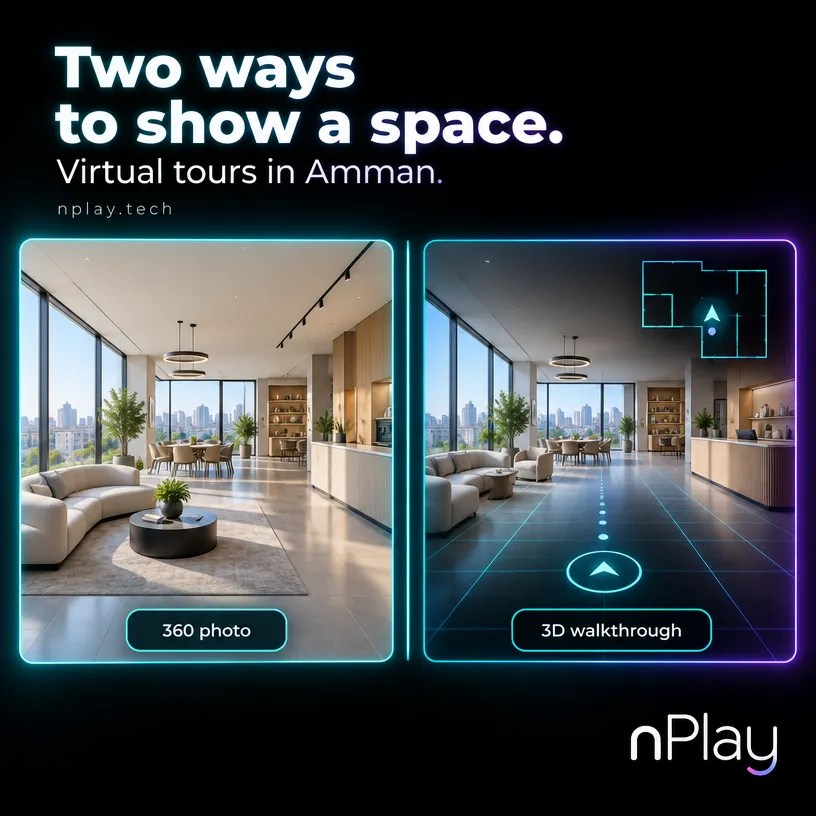
    virtual tour for universities jordan: Two ways to show a space: virtual tours by Nplay
    Two ways to show a space: virtual tours by Nplay
  • Virtual events won’t replace the venue — they’ll double it

    Virtual events won’t replace the venue — they’ll double it

    Virtual event platform saudi arabia: a practical guide from Nplay. This article covers what matters about virtual event platform saudi arabia, from the first idea to delivery.

    Picking a virtual event platform? Saudi Arabia’s organisers are planning hybrid shows for the decade ahead. Every few years someone announces that virtual events will kill the conference hall, and every few years the halls fill up again. The numbers tell a more interesting story: the virtual events market is forecast to grow more than fivefold by 2030 while venues stay busy, because organisers are adding a second, virtual venue to the first. Here is what we learned running one, and how Nplay Nexus, FrontRow and Live fit together.

    Virtual events won't replace the venue — they'll double it

    The venue is not dying. It is being copied.

    The pandemic years produced a confident prediction: once people discovered they could attend a summit from their kitchen, the exhibition hall would empty. It did not happen. Halls in Riyadh, Dubai and Amman are booked out, and the exhibition calendar is as crowded as it has ever been.

    What did happen is quieter and, for organisers, more valuable. The virtual layer did not replace the venue; it copied it. A conference now has a physical hall with 800 seats and a virtual hall with no seat limit. An exhibition has 200 stands on the floor and 200 branded booths online, some belonging to exhibitors who could never have shipped a stand across a border. The venue doubled.

    The market data cited in Nplay’s business brief describes exactly this. The virtual events market is forecast to expand from USD 79.36 billion in 2023 to USD 435.36 billion by 2030, a compound annual growth rate of 27.5 per cent, and the driver named in that research is not the death of the in-person event but the rise of hybrid formats: 80 per cent of event planners are now integrating virtual components into their strategies. A more conservative series in the same brief still puts growth at 18.8 per cent a year over 2024–2030. Either way, the virtual venue is becoming standard equipment.

    The numbers

    Virtual events by the numbers

    $435BForecast virtual events market by 2030, from USD 79.36B in 2023Industry research cited in Nplay’s business brief
    27.5%Forecast compound annual growth rate to 2030 (a more conservative series: 18.8%)Industry research cited in Nplay’s business brief
    80%Of event planners integrating virtual components into their strategiesIndustry research cited in Nplay’s business brief

    What we learned running a fully virtual Arab summit

    Our team helped build and run the first fully virtual Arab summit — an event held entirely inside a virtual expo centre. There was a reception hall, an auditorium for keynotes and panels, meeting rooms for the side conversations that are the real reason people attend summits, and a booth floor where exhibitors designed their own branded stands, loaded documents and films onto the booth screens and staffed them with live chat. Attendees joined as avatars from wherever they were, in a web browser, with nothing to install.

    Three lessons came out of it and they now shape everything we build for events.

    Design it as a venue. The events that fail online are websites with a 3D skin. The ones that work have a floor plan, sightlines, a route from the entrance to the auditorium, and somewhere to loiter. People behave in a virtual hall the way they behave in a real one: they look for the coffee.

    Give the exhibitor a reason. Exhibitors paid for booths because they could see who visited, for how long, and what they downloaded. Without that dashboard a virtual booth is a brochure. With it, it is a lead machine that works in every time zone.

    You can read the full account in our virtual summit case study. The third lesson deserves its own section, because it is about what most organisers miss.

    The three layers of a hybrid event — and the one everyone skips

    When organisers say “hybrid” they usually mean two things: the physical venue and a live stream of the main stage. That is a broadcast, not a second venue. The people watching cannot meet each other, cannot visit a stand, cannot ask a question at the booth. They are an audience, not attendees.

    The third layer is the 3D venue itself — the halls, booths and meeting rooms that the remote attendee can walk through as an avatar, with the live stream playing inside its auditorium. This is the layer that doubles the venue rather than merely televising it, and it is the one most organisers skip because until recently it was expensive to build and awkward to attend.

    The three layers do different jobs:

    • Physical venue — the stage, the handshake, the dinner. Irreplaceable and capacity-limited.
    • Live stream — reach. Anyone, anywhere, watching the main stage; pay-per-view, subscription or free.
    • 3D virtual venue — participation. Booths, networking, side meetings and sponsorship for people who are not in the hall.

    A well-run hybrid event uses all three and lets an attendee move between them: watch the keynote on the stream, walk to a booth in the 3D venue, book a meeting for the physical day. That is the design target for our own platforms.

    Compare

    Venue only, venue plus stream, venue plus 3D venue

    CapabilityPhysical venue onlyVenue + live streamVenue + stream + 3D virtual venue
    Attendance capacityLimited by the hallUnlimited viewersUnlimited attendees who can act, not just watch
    Exhibitor reachVisitors on the floorLogos on screenBranded booths visited from anywhere, with visit analytics
    NetworkingCorridors and coffeeChat boxSocial hall, meeting rooms, avatar-to-avatar conversation
    Sponsorship inventoryBanners, stagePre-roll, overlaysVenue branding, booth tiers, session sponsorship, virtual merchandise
    Data for organiserBadge scansView countsWho visited which booth and session, for how long, and what they bought
    TicketingSeatsAccess codes3D seat selection for the hall plus virtual passes for the venue

    How Nexus, FrontRow and Live divide the work

    We are building three products for these three layers, and we should be clear that all three are in development rather than on the shelf. They grow directly out of the summit and out of years of live-broadcast work.

    Nplay Nexus is the virtual exhibition and convention platform: a 3D venue with a main hall, an auditorium, meeting rooms and a booth floor, navigated in a browser with a customisable avatar. Exhibitors reserve and design booths from an interactive map; speakers run live sessions in the auditorium; a social hall with chat “bubbles” handles the corridor conversations; and every exhibitor and speaker gets a dashboard of who visited, who attended and what was sold.

    Nplay FrontRow handles the physical side: a 3D model of the real venue in which attendees walk the hall, check the sightline from a seat and book it, while organisers upload the venue, define seating and booths and go live. It exists because the physical venue is not going anywhere and deserves the same care as the virtual one.

    Nplay Live is the streaming and video-on-demand layer: a desktop studio for the creator, a mobile app for the viewer, ticketing and a wallet, pay-per-view or subscription, built to carry a main stage to a very large concurrent audience. Our immersive broadcasting service covers the production side.

    Together they are the second venue. Separately, each solves one layer for organisers who already have the other two.

    Five things organisers get wrong the first time

    Because we have made most of these mistakes ourselves, here is the list we now give every organiser before a hybrid event.

    1. Treating the stream as the virtual event. A stream is reach. If remote attendees cannot visit a booth or meet someone, you have a broadcast with a registration form.
    2. Building the 3D venue as a website. Menus and tiles are not a venue. Give people a floor plan and a route.
    3. Selling virtual booths without a dashboard. Exhibitors renew when they can count leads. Make the analytics the headline of the booth package.
    4. Ignoring time zones and language. A Gulf summit attracts attendees from Jakarta to Casablanca. Sessions need on-demand replays, and the venue needs Arabic and English from the first screen.
    5. Requiring a headset. The virtual venue must run in a browser and on a phone. A headset is a bonus for the few, not a barrier for the many.

    None of these is a technology problem. They are design decisions, and they are why we prefer to be involved before the floor plan is drawn rather than after the platform is chosen. If you are planning a large gathering in Saudi Arabia or Jordan next season, the cheapest time to talk to us is now.

    FAQ

    Virtual event platform Saudi Arabia: frequently asked questions

    Where do the virtual events market figures come from?

    From industry research cited in Nplay’s business brief, which forecasts growth from USD 79.36 billion in 2023 to USD 435.36 billion by 2030 at a 27.5 per cent CAGR, driven by hybrid adoption, with 80 per cent of planners integrating virtual components. A more conservative series in the same brief gives 18.8 per cent.

    Are Nplay Nexus, FrontRow and Live available now?

    All three are in development. They build on the fully virtual Arab summit our team helped deliver and on our live-broadcast work. Contact us to discuss pilots for upcoming events.

    Do attendees need VR headsets for a virtual venue?

    No. The venue runs in a standard web browser and on mobile; a headset adds immersion for those who have one but is never required to attend, exhibit or buy.

    What does an exhibitor get from a virtual booth that a stream cannot give?

    A branded 3D space visitors walk into from anywhere, live chat and a virtual assistant, document and video downloads, and a dashboard showing who visited, for how long and what they bought or requested.

    Further reading: Extended reality (Wikipedia)

    Quick questions about virtual event platform saudi arabia

    Who is virtual event platform saudi arabia for? Companies and institutions that want a clearer, faster experience for their customers and visitors.

    How long does virtual event platform saudi arabia take? It depends on the size of the project and the content needed. We confirm the timeline after a short discovery call.

    How do I start with virtual event platform saudi arabia? Contact the Nplay team in Amman or Riyadh and we will suggest a clear first step.

    Does virtual event platform saudi arabia work in Arabic and English? Yes. We prepare the content in both languages from day one.

    virtual event platform saudi arabia: VR training demo by Nplay at an exhibition
    VR training demo by Nplay at an exhibition
    Holographic display in a mall atrium by Nplay
    Holographic display in a mall atrium by Nplay
    Virtual 3D event space built by Nplay
    Virtual 3D event space built by Nplay

    In short, virtual event platform saudi arabia works best when it starts from a clear goal. Nplay plans virtual event platform saudi arabia around your audience, your space and your budget. If you are comparing options for virtual event platform saudi arabia, ask for a live demo before you decide. We are happy to answer any question about virtual event platform saudi arabia.

  • Virtual museum and heritage tours: reaching visitors who cannot come

    Virtual museum and heritage tours: reaching visitors who cannot come

    Virtual tour for museums jordan: a practical guide from Nplay. This article covers what matters about virtual tour for museums jordan, from the first idea to delivery.

    A museum is open for a few hours a day to people who can travel to it. Its collection, and the story it tells, could reach far more. A virtual tour for museums Jordan institutions can commission does not replace the visit; it opens a second entrance for schools, the diaspora, researchers and tourists still deciding where to go, the same idea behind a virtual tourism experience Saudi Arabia destinations can offer overseas visitors. This guide covers what a heritage tour should do, how rooms and objects are captured differently, and where holograms and virtual tourism fit, with reference to our museum and university tours page.

    Virtual museum and heritage tours: reaching visitors who cannot come

    A virtual museum is a second entrance, not a substitute

    Museums in Jordan and Saudi Arabia share a problem: the people who would benefit most from the collection are often the ones least able to reach it. A school in a distant governorate, a student abroad, a researcher who needs to see an object before travelling, a visitor who cannot manage the stairs. A physical visit remains the best experience. A tour makes the collection available to everyone else, and makes the visit more likely for those who might otherwise not plan one.

    That is how we think about a virtual tour for museums Jordan teams commission. It is not a digital copy that competes with the building. It is an addition to the museum’s services, with an audience, an owner and a reason to be updated. The heritage programmes that disappoint are usually those built as a showcase for launch day, then left without a budget, a curator or a process for adding the next gallery.

    We build tours as part of our virtual tours service, and the heritage programme we describe on our heritage metaverse page applies the same discipline at national scale.

    Three jobs

    What a heritage tour can do

    Reach

    Bring the collection to people who cannot come

    Online 360 tours of galleries, with hotspots that open object stories in Arabic and English, for schools, diaspora and overseas visitors.

    Enrich

    Add depth inside the building

    Hologram screens, projection and touch displays that tell the stories objects cannot tell alone. These run on site, managed from one dashboard.

    Record

    Keep an accurate digital record

    3D scans of artefacts and surveyed models of rooms support conservation, research and insurance, and feed every other use.

    Audiences

    Who a museum tour is for, and what each needs

    AudienceWhat they needFormatNote
    School groupsGuided, age-appropriate journeys before or after a visit360 tour with story hotspots and quizzesArabic and English; teacher notes
    Overseas visitors and diasporaOrientation and a reason to travelShort film plus 360 tour; hologram guide at fairsLanguage and time-zone friendly
    Researchers and conservatorsAccurate detail of objects and rooms3D scans and measured room modelsCapture to the conservator’s rules
    Visitors with limited mobilityAccess to galleries they cannot reach360 tour with full gallery coverageInclude accessible routes on site too
    Tourism bodies and tour operatorsA preview to sell the visitEmbeddable tour and destination filmLink with destination programmes

    Rooms and objects are captured differently

    A gallery is a place: it is captured from fixed points as a 360 tour, with hotspots placed on the objects that matter. An artefact is a thing: it is captured by 3D scanning, which produces a model the viewer can turn, zoom and examine. The two are planned differently, and confusing them is the commonest source of a weak brief.

    Both are planned around the conservator, not the camera. Light levels, handling restrictions, time windows and security determine how long the team can work and what equipment it can use. Fragile or light-sensitive pieces may be scanned in short sessions or modelled from reference photographs instead. We agree those rules before any equipment arrives, and they are written into the schedule.

    Our studio scans physical objects into 3D and animates them for tours, holograms and learning content, which we describe on the 3D content studio page. The same scan that appears in an online tour can be rotated at life size on a hologram display in the gallery.

    Museum hologram Jordan: what holograms add, and what they do not

    In May 2023 we installed a hologram and projection route in a national military memorial in Jordan: rear-projection hologram screens, a filmed virtual speaker welcoming visitors, floor projection and renewed dome projectors. It ran on site in roughly three weeks and connects ten displays to a cloud dashboard that museum staff operate themselves. The case study gives the full account.

    A museum hologram Jordan visitors see inside the building is a projection system: a dark screen, a projector behind it and a film written to be watched on it. It adds presence, a figure standing where the story happened, but it needs controlled light and a real script. Holograms are best for the two or three moments that deserve a figure, not for every label. Our post on projection mapping for museums explains which projector goes where.

    The market

    Why virtual tourism is growing

    22%Share of metaverse investment expected to go to travel and tourism by 2030Metaverse research report cited in Nplay’s market brief
    100MTourists a year targeted by Saudi Arabia by 2030National tourism target, as cited in Nplay’s market brief
    27.9%Projected compound annual growth of the virtual tours market, from about USD 0.96 billion in 2023 to about USD 8.4 billion by 2030Allied Market Research, as cited in Nplay’s market brief

    A virtual tourism experience for Saudi Arabia

    Saudi Arabia is building a tourism sector at speed, and heritage is central to it. A virtual tourism experience Saudi Arabia visitors can try before they book combines three things: immersive tours of heritage and landmark sites, hologram guides at visitor centres and fairs, and on-demand films that work as previews.

    Our 2024 proposals for this market include a programme of immersive 3D on-demand recordings of twenty tourism locations, and hologram tour guides, AI avatars that answer visitors’ questions in their own language. These are proposed programmes built on delivered Nplay products rather than completed national projects, and we describe them as such on our destination tourism page. The value for a museum or heritage site is the same in either country: the people who see a good preview are more likely to visit.

    Accuracy is a workflow, not a promise

    Heritage content carries a particular responsibility. A wrong date, a mislabelled object or a careless reconstruction damages trust in the institution. So we treat accuracy as a process with named owners: the museum’s historians review the script and storyboard before 3D production begins, approve the final cut, and sign off each update afterwards.

    That is how the memorial project ran, with story drafts reviewed and approved by the client before any modelling. It is also why we recommend a named owner inside the museum for the tour, a simple update calendar, and Arabic and English content written together rather than translated later. Tours built this way stay credible, and staff can add a gallery without calling us.

    FAQ

    Virtual tour for museums Jordan: frequently asked questions

    Does a virtual tour reduce visits to the museum?

    We have no evidence either way and will not invent any. A good tour is a preview and a teaching tool; our reasoning is that people who know what a collection holds are more likely to plan a visit.

    How are fragile objects scanned?

    Around the conservator’s rules on light, handling and time. Some pieces are scanned in short sessions or modelled from reference photographs, and we agree this before work starts.

    Can the same 3D assets be used online and in the gallery?

    Yes. A scan or model made for the online tour can also drive a hologram or touch display in the building, which is why we plan both together.

    Who updates the tour after launch?

    The museum’s own team, using content tools we hand over, with historians approving changes. We can support that workflow or take it on as a service.

    Further reading: Virtual tour (Wikipedia)

    Quick questions about virtual tour for museums jordan

    Who is virtual tour for museums jordan for? Companies and institutions that want a clearer, faster experience for their customers and visitors.

    How long does virtual tour for museums jordan take? It depends on the size of the project and the content needed. We confirm the timeline after a short discovery call.

    How do I start with virtual tour for museums jordan? Contact the Nplay team in Amman or Riyadh and we will suggest a clear first step.

    Does virtual tour for museums jordan work in Arabic and English? Yes. We prepare the content in both languages from day one.

    virtual tour for museums jordan: Holographic display in a mall atrium by Nplay
    Holographic display in a mall atrium by Nplay
    Hologram display box showcase by Nplay
    Hologram display box showcase by Nplay
    Life-size hologram museum guide by Nplay in Jordan
    Life-size hologram museum guide by Nplay in Jordan

    In short, virtual tour for museums jordan works best when it starts from a clear goal. Nplay plans virtual tour for museums jordan around your audience, your space and your budget. If you are comparing options for virtual tour for museums jordan, ask for a live demo before you decide. We are happy to answer any question about virtual tour for museums jordan.

  • Virtual showroom in Riyadh: retail, furniture, cars and malls

    Virtual showroom in Riyadh: retail, furniture, cars and malls

    Virtual showroom riyadh: a practical guide from Nplay. This article covers what matters about virtual showroom riyadh, from the first idea to delivery.

    A showroom exists so that people can judge before they buy. A virtual showroom lets them do it at midnight, from another city, on a phone. This guide looks at four kinds of space where we see the idea working in Saudi Arabia and Jordan: shops, furniture stores, car dealerships and shopping malls. It sets out which format fits each, what has to be captured or modelled, and what to settle with your supplier. Our virtual tours service covers the build.

    Virtual showroom in Riyadh: retail, furniture, cars and malls

    A showroom that never closes

    Most buyers of a sofa, a car or a fashion collection want to see it before they commit, and most no longer start in the shop. They start on a phone, compare two or three sellers and only then decide where to go. A virtual showroom Riyadh retailers build today answers the first visit for them: the space, the range, the scale of things and the next step.

    The same holds for a virtual showroom Jordan customers can open from Amman, Irbid or abroad. A customer in another city, or a family planning a purchase over the weekend, sees the store without the drive. The wider market is moving the same way: virtual tours are projected to grow from about USD 0.96 billion in 2023 to about USD 8.4 billion by 2030 (27.9% CAGR), per Allied Market Research as cited in Nplay’s market brief. A showroom is one of the most natural uses of that growth, because the visitor arrives with a purchase in mind.

    We build these from our Amman 3D content studio, and we work with clients in Riyadh. We would rather explain what suits your stock than sell you the largest option.

    Four kinds of space

    What each kind of showroom needs

    Retail and fashion

    Shops with changing stock

    A 360 tour of the real shop gives the feel of the space. Because stock changes weekly, put the focus on zones, displays and featured items, and link each to a product page or an enquiry.

    Furniture and interiors

    Room sets and arrangements

    Buyers want scale and combinations: does the sofa fit, does the colour work with the floor. Photograph room sets, then add 3D models of key pieces so they can be turned and shown in alternative finishes. Nplay Vista, our concept real-estate platform, explores furniture simulation in full rooms.

    Cars and vehicles

    Dealerships and stock

    A tour of the showroom floor builds trust in the dealer. The vehicles themselves work best as 3D views built from the approved files your brand supplies, with colours and wheels where the maker allows, and a link to book a test drive.

    Malls and centres

    One map, many tenants

    A centre-level tour of entrances, atriums and corridors, with store markers that open each tenant’s own tour or page. It helps visitors plan a visit and helps tenants share one consistent map.

    Choosing

    Which format for which showroom

    ShowroomBest formatWhat we capture or buildWatch out for
    Shop with changing stock360 photo tour with product hotspotsThe space at its best, plus featured displaysDated stock makes the tour look neglected; agree a refresh schedule
    Furniture room sets360 tour plus 3D models of key piecesRoom sets, and scanned or modelled hero itemsColour and scale must be right; show real dimensions
    Car dealership360 of the floor, 3D views of vehiclesThe showroom, and models built from approved brand filesOnly show colours and options the dealer can deliver
    Shopping mallCentre-level 360 with tenant linksCommon areas, wayfinding points and entrancesTenants change; plan who edits the map
    Showroom not yet builtModelled 3D walkthroughThe design from approved drawingsLabel renders as impressions until it opens

    Show the product, not only the room

    A tour of the room answers where. A product view answers what. For items that buyers want to turn in their hands, such as furniture, lighting, bags, watches and small appliances, we scan physical pieces or model them from your files and publish them as 3D views that rotate in the browser, with colour variants where they exist. Our 3D content studio already does this scanning for hologram and signage content, so one model can serve several uses.

    Two rules keep it honest. First, colour: calibrate against the real item and say if a screen may show it slightly differently. Second, size: show dimensions and, where helpful, a size reference such as a door or a person. A buyer who is surprised by the size will return the item, and no tour can recover that goodwill.

    From looking to asking

    A virtual showroom that ends with a beautiful view and no next step wastes the visit. Place an enquiry hotspot on each area or product: request a call-back, ask about availability, book a viewing or reserve a test drive. Route each one to the person who can answer, and make sure the message says which item the visitor was looking at.

    Where your online store or booking system has an interface for it, the tour can send the visitor straight to the product or the booking form; we scope that in the project. The tour leads and your existing systems complete the sale. We do not quote conversion figures, because every retailer’s audience is different. Measure enquiries from the tour against your own baseline.

    Malls: one tour, many tenants, more screens

    A mall has two audiences: shoppers planning a visit, and tenants who want to be found. A centre-level tour serves both, and it can do more work when the assets travel. The same 3D content can drive a directory screen on Nplay Beam digital signage, and a Halo Box hologram store can put a product in front of shoppers who are already in the building. Our article on hologram stores in malls and metro stations explains how that store works.

    For a virtual showroom Riyadh shoppers will open in Arabic first, build the Arabic interface as a first-class version, with right-to-left labels, not a translation added at the end.

    Before you brief

    What to settle with your supplier first

    • Which areas and products must be in the tour, and which change most often
    • Who approves product images, colours and brand use before publishing
    • Who updates the tour when stock, prices or layouts change, and how quickly
    • Which enquiry route each hotspot uses, and who answers it
    • Whether Arabic and English are both needed, and on which devices the tour must work
    • Who owns the source images and models when the project ends
    FAQ

    Virtual showroom in Riyadh: frequently asked questions

    Do customers need an app or a headset to open a virtual showroom?

    No. A tour opens in a normal phone or computer browser. A headset version can be added for an event stand or a sales floor, but it is optional.

    Can a virtual showroom take payments?

    Where your store or booking system allows it, the tour can link to the product or booking page, and we scope that in the project. The tour’s main job is to bring the right visitor to the right product.

    Is a virtual showroom Jordan retailers can build different from one in Riyadh?

    The method is the same. Differences are practical: access hours, permissions in malls and the languages you need. We work in both markets and can plan a shared brief for two cities.

    How do we keep it current when stock changes?

    Agree it up front. Product views and hotspots can be edited without rebuilding the tour, and a photographed room can be partly re-shot. We set an update routine in the project scope.

    Further reading: Virtual tour (Wikipedia)

    Quick questions about virtual showroom riyadh

    Who is virtual showroom riyadh for? Companies and institutions that want a clearer, faster experience for their customers and visitors.

    How long does virtual showroom riyadh take? It depends on the size of the project and the content needed. We confirm the timeline after a short discovery call.

    How do I start with virtual showroom riyadh? Contact the Nplay team in Amman or Riyadh and we will suggest a clear first step.

    Does virtual showroom riyadh work in Arabic and English? Yes. We prepare the content in both languages from day one.

    3D virtual tours for properties and showrooms by Nplay
    3D virtual tours for properties and showrooms by Nplay
    3D city model digital twin by Nplay
    3D city model digital twin by Nplay

    In short, virtual showroom riyadh works best when it starts from a clear goal. Nplay plans virtual showroom riyadh around your audience, your space and your budget. If you are comparing options for virtual showroom riyadh, ask for a live demo before you decide. We are happy to answer any question about virtual showroom riyadh.

    virtual showroom riyadh: Two ways to show a space: virtual tours by Nplay
    Two ways to show a space: virtual tours by Nplay
  • Virtual tour cost in Jordan and Saudi Arabia: what moves the quote

    Virtual tour cost in Jordan and Saudi Arabia: what moves the quote

    Virtual tour saudi arabia: a practical guide from Nplay. This article covers what matters about virtual tour saudi arabia, from the first idea to delivery.

    Ask five suppliers for a virtual tour and you will get five numbers that do not match. The gap is rarely greed. It is usually the brief. This guide explains what drives virtual tour cost in Jordan and Saudi Arabia, without quoting a single price, and ends with a one-page brief you can send to every supplier so the quotes can be compared fairly. We build tours ourselves, so we have written it the way we would want to be briefed. Start with our virtual tours service if you want the formats first.

    Virtual tour cost in Jordan and Saudi Arabia: what moves the quote

    Why we will not put a price in a blog post

    Search for virtual tour cost Jordan and you will find either a figure with no context or a request to call. We understand the frustration. We do not publish a rate card either, and the reason is practical: the same phrase covers a single cafe photographed in a morning and a campus modelled over months. Any number we printed would be wrong for most readers.

    What we can do is tell you what moves the total, so you can tell a fair quote from a thin one. The same logic applies whichever supplier you choose, including a virtual tour company Riyadh developers and retailers already use. If you have not yet chosen a format, read 360 photos, 3D walkthroughs or video first, because format is the largest single driver.

    Drivers

    Six things that move virtual tour cost

    Each one can be changed in the brief. Knowing which are fixed and which are choices is most of the work of buying well.

    Size

    Space and number of viewpoints

    Every room, corridor or stand needs its own viewpoint or modelled volume. More viewpoints mean more capture and editing effort, so decide early which areas visitors really need.

    Format

    Photograph it or model it

    A 360 photo tour records what exists. A 3D model is built from drawings or scans and can show what does not exist yet. They need different crews, different software and different amounts of time.

    Conditions

    How hard the place is to capture

    Occupied hotels, trading shops, mall corridors and heritage sites often need night or early-morning access, permissions and staff to move furniture. Outdoor and adventure sites add weather and travel.

    Interaction

    The information layer

    Hotspots, floor plans, audio guides, video, finish options and enquiry buttons are each small work items that add up. A tour with no layer is a set of pictures; a rich one is a small application.

    Audience

    Languages and devices

    Arabic with right-to-left layout and English are two interfaces to write, check and test. A headset version is a separate build, on top of the phone version most people will use.

    After launch

    Hosting, updates and ownership

    Who hosts the tour, how long for, who edits it when a unit sells or a menu changes, and whether you own the source files or rent access. Cheap at launch can be costly in year two.

    What changes between Amman and Riyadh

    The drivers are the same in both cities, but they weigh differently from project to project. Large sites such as towers, malls and developments, with many floors and many tenants, bring permissions and night access into the schedule. A single property, hotel or venue turns more on the number of days on site and the number of rooms.

    We work from Amman, where our 3D studio is, and from Riyadh. A 3D tour built from drawings can be produced in Amman and reviewed with your team in Riyadh by video and a private link; capture on site happens in the city where the space is. If you are briefing a supplier in Amman and a virtual tour company Riyadh businesses use for the same client, give both the same template below so the two quotes can be read together.

    Brief template

    The one-page brief: what to write in each field

    Copy this into an email. Every field removes a question the supplier would otherwise price as a risk.

    FieldWhy it moves the quoteWhat to write
    Place and purposeDecides format, detail and toneType of space, city, who will view the tour and what action you want
    Spaces to includeSets viewpoints or model sizeA room list or floor plans, with priority areas marked
    State of the spaceExisting space can be photographed; a planned one must be modelledFinished, occupied, under construction or not yet designed
    AccessDrives schedule, crew and permissionsDays and hours on site, who opens the door, any restrictions
    InteractionSets production time on top of captureHotspots, floor plan, audio, video, finishes, enquiry button
    LanguagesMultiplies writing and testingArabic, English, others; right-to-left needed or not
    DevicesSets optimisation and testing effortPhones, desktop, headset, in-venue screen
    Hosting and updatesDecides the cost after launchWho hosts, for how long, expected changes per year
    OwnershipDecides what you can do laterSource images and models handed over, or access only
    Timing and approvalsAffects crew planningLaunch date, who approves, how many revision rounds

    A short cover note to go with the brief

    The table is the substance. The note around it should be short and identical for every supplier:

    We are commissioning a virtual tour of [place], [city], for [audience], to be launched by [date]. The attached brief lists the spaces, access, languages, devices and hosting we need. Please quote against it exactly, and list separately anything you have excluded or assumed. Please also send a live example we can open on a phone, and tell us who owns the source files when the project ends.

    That last request is the most revealing. A supplier who answers the ownership and live-example questions directly is usually pricing honestly. One who sends only a showreel and a single figure is asking you to compare something that cannot be compared.

    Reading the quote

    What a fair quote itemises

    • Capture or modelling, shown separately, with the number of viewpoints or the modelled area
    • Post-production: stitching, colour matching, clean-up and any retouching of furniture or clutter
    • The information layer: hotspots, floor plan, audio, video and enquiry buttons
    • Each language, including right-to-left layout and proofreading by a native writer
    • Hosting, for how long and on whose domain, and what an update costs afterwards
    • Revision rounds included, and what counts as a revision rather than a change of scope
    • Ownership of files, and whether another supplier can edit them later
    FAQ

    Frequently asked

    Why can’t you give even a rough virtual tour cost?

    Because any figure for virtual tour cost Jordan buyers might hear sits in a range that runs from a single-room photo tour to a modelled development, which is too wide to average honestly. Send the brief and we will quote your project after a short scoping call, for Amman, Riyadh or both.

    Is a 360 tour always cheaper than a 3D model?

    As a rule a 360 photo tour of an existing space takes less effort than a modelled walkthrough of the same space, but a very large site with difficult access can reverse that. Scope decides, not the label.

    Does cost rise with every language?

    Yes, modestly. Each language needs writing, checking and testing, and Arabic adds right-to-left layout. Planning both from the start is usually simpler than adding Arabic later.

    What should I never drop to save money?

    Testing on real phones, and a clear agreement on who updates the tour. A tour that loads slowly or goes out of date wastes the whole project.

    Further reading: Virtual tour (Wikipedia)

    Quick questions about virtual tour saudi arabia

    Who is virtual tour saudi arabia for? Companies and institutions that want a clearer, faster experience for their customers and visitors.

    How long does virtual tour saudi arabia take? It depends on the size of the project and the content needed. We confirm the timeline after a short discovery call.

    How do I start with virtual tour saudi arabia? Contact the Nplay team in Amman or Riyadh and we will suggest a clear first step.

    Does virtual tour saudi arabia work in Arabic and English? Yes. We prepare the content in both languages from day one.

    3D virtual tours for properties and showrooms by Nplay
    3D virtual tours for properties and showrooms by Nplay
    3D city model digital twin by Nplay
    3D city model digital twin by Nplay

    In short, virtual tour saudi arabia works best when it starts from a clear goal. Nplay plans virtual tour saudi arabia around your audience, your space and your budget. If you are comparing options for virtual tour saudi arabia, ask for a live demo before you decide. We are happy to answer any question about virtual tour saudi arabia.

    virtual tour saudi arabia: Two ways to show a space: virtual tours by Nplay
    Two ways to show a space: virtual tours by Nplay