AI agents for business in Jordan and Saudi ArabiaBuilt as projects in Jordan & Saudi Arabia
Nplay builds AI agents that answer customers, qualify leads and take routine work off your team, in Arabic and English, on your website, WhatsApp and the phone. They read from your own knowledge and systems, act inside permissions you set, and pass to a person when a case needs judgement. We work from Amman and Riyadh and start with one process, not a company-wide programme.
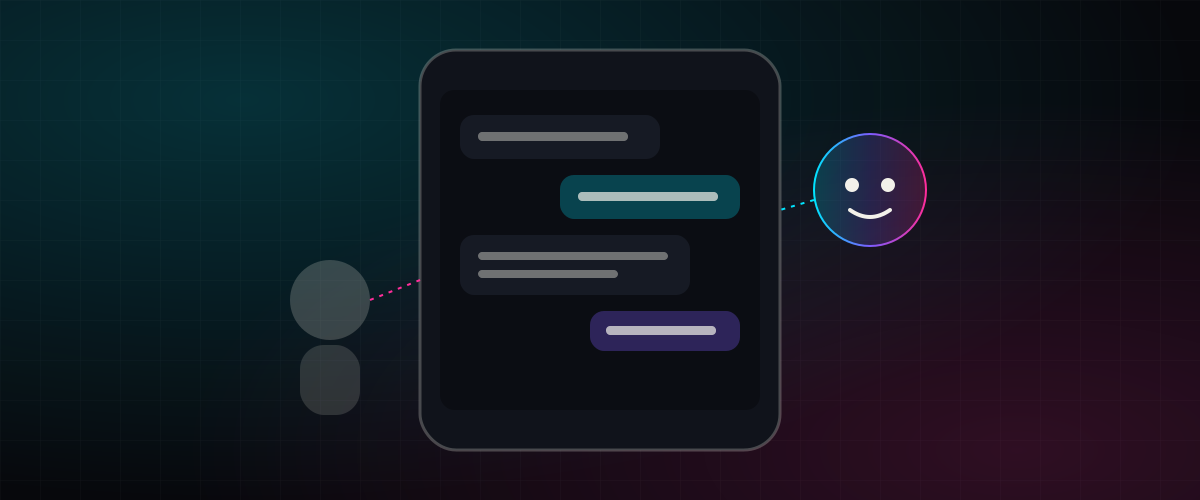
An AI agent reads, decides, acts and hands over
An AI agent is software that can read a request, decide what to do, use your tools and data to do it, and report back. A customer asks about a delivery. The agent finds the order in your system, reads the status, replies in the customer's language and, if the order is stuck, opens a ticket for a person. That sequence of understanding, looking up and acting is what separates an agent from a script.
AI agents for business work best on repetitive, rules-based, high-volume tasks: answering the same twenty questions, sorting incoming enquiries, drafting a document from a template, checking a record. They do not replace the people who handle exceptions, negotiate or carry responsibility. They remove the queue in front of those people.
As an AI agent development company Amman businesses can brief in Arabic or English, and with a team in Riyadh, we treat every agent as a small operating procedure written in software. First we write down what the process is, then what the agent may do, then what it must hand over.
Agent versus chatbot
A chatbot follows a fixed menu or matches a question to a canned answer. An agent understands free-form language, keeps the context of the conversation, pulls facts from a knowledge bank and can call tools, for example to look up a record, book a slot or draft a reply. It can also say it does not know, which is a feature. The table below sets out the differences, and our guide on AI agents vs chatbots vs automation goes further.
Connected to your systems
An agent that cannot see your data only guesses. Our integration work, which covers ERP, CRM and CMS systems including Odoo and custom APIs, is what lets an agent read an order, update a lead or create a task. Teams that ask us about AI workflow automation Jordan companies can run in-house usually already have the data; the gap is the connection. Where a front end is needed, our web development and business portal work gives the agent a place to live, such as a customer or staff portal.
Arabic and voice
Arabic is a first-class language for our agents, not a translation layer added later. A voice AI agent Arabic callers can speak to has to cope with Modern Standard Arabic, Gulf and Levantine dialect, code-switching into English and the noise of a real phone line. We test voice agents on recordings and live calls from your own setting before they answer anyone. Read more in Arabic voice AI agents for customer calls.
Go deeper
Chatbot, rules automation or AI agent: which do you need
None of the three is always best. Fixed rules are cheaper and more predictable when the process never varies. Agents earn their place where the input is messy and the work needs lookups.
| Criteria | Chatbot (menu or FAQ) | Rules automation | AI agent |
|---|---|---|---|
| How it works | Fixed menu or keyword match to a prepared answer | If-this-then-that steps set by a developer | Understands free text, plans steps and uses tools within set permissions |
| Handles free-form Arabic and English | Poorly, outside its scripted phrases | Not applicable: it needs structured input | Yes, including dialect and mixed-language messages, tested per deployment |
| Uses your data | Only what is written into its answers | Yes, through fixed field mappings | Yes, reads and writes through connected systems and a knowledge bank |
| Handles the unexpected | Dead end or repeats the menu | Stops or fails the rule | Asks a clarifying question or hands over to a person |
| Predictability | Very high | Very high | High when guardrails and tests are in place, but never absolute |
| Setup effort | Low | Medium, per workflow | Medium to high: knowledge, integrations and testing on real cases |
| Best for | Opening hours, simple FAQs, routing | Stable back-office steps: copy data, send a reminder | Support, lead qualification, document intake, internal look-ups |
Six kinds of AI agent for business
Most projects start with one of these and grow into a second.
Customer-service and sales agents
An agent that answers product, price-list, booking and order questions in Arabic and English, captures lead details and passes hot or sensitive conversations to your team with the full transcript.
Customer service and sales use case →Customer-service and sales agentsKnowledge-bank agents
The approach behind our AI avatars: you teach the agent your policies, catalogues and procedures, and it answers only from that material. It can cite the source page, and staff can update the bank without rewriting code.
AI hologram avatar →Knowledge-bank agentsVoice agents
Agents that take calls, understand spoken Arabic and English, answer from your knowledge bank, book appointments and pass callers to a person on request. Suitable for clinics, hotels, service desks and after-hours lines.
AI receptionist and hologram avatar
The same conversational backend behind a screen or a life-size avatar in a lobby, showroom or mall. Visitors talk to it; it greets, answers and directs. The AI Receptionist is available today.
AI Receptionist →AI receptionist and hologram avatarBack-office workflow agents
Agents that draft quotes, read incoming invoices, schedule, answer HR onboarding questions, prepare reports and look up stock or orders in your ERP. They draft and prepare; your staff approve.
Operations and back-office use case →Back-office workflow agentsInternal knowledge assistants
One place where employees ask how a policy works, where a template is or what the price of an item was last quarter, with answers drawn from your own documents and a list of the files used.
From one process to an agent in daily use
Pick one process
We choose a single process with clear volume and a clear owner, such as first-line customer enquiries or quote drafting. A narrow start gives a fair test and quick learning.
Map it
We write down the real steps, the exceptions, the questions people ask and who decides what. This map becomes the agent's instructions and its hand-off rules.
Connect knowledge and systems
We load your documents into a knowledge bank and connect the systems the agent needs, read-only first, with write access added only where it is justified.
Test on real conversations
We run the agent against real past enquiries, recorded calls and edge cases, in Arabic and English, and fix the failures with your team before it meets a customer.
Launch with human hand-off
The agent goes live on one channel with a clear route to a person, an internal note for each hand-over and a review of every conversation in the first period.
Measure
We agree the measures up front, such as the share of conversations resolved without a person, hand-over quality, response time and staff feedback, and review them with you.
Expand
When the first process is stable, we add a channel, a language, a second process or deeper system access, using what the logs showed.
Controls we build into every agent
An agent is only as safe as the limits around it. These are set before launch and reviewed after.
Permissions
Each agent gets the least access it needs. It may read an order but not refund it, or draft a quote but not send it. Permissions are written down and approved by the process owner.
Logging
Conversations and the actions an agent takes are recorded, so you can see what was asked, what was answered and which records were touched.
Human-in-the-loop
Money, contracts, complaints, medical or legal questions and anything the agent is unsure about go to a named person. The customer is told a person is taking over.
Grounded answers
The agent answers from your knowledge bank. When the answer is not there, it says so and escalates rather than inventing one.
Data handling
We agree what personal data the agent sees, where it is stored, how long it is kept and who can read the logs, and we design to the rules of each market.
Review and improvement
Reviewers sample conversations, mark errors and feed corrections into the knowledge bank and instructions. Agents are maintained, not installed once.
Where AI agents are not a fit
- Processes that change every week, have no owner or exist only in one person's head: write the process down first
- Decisions with legal, financial or safety consequences that nobody is prepared to review
- Work with very low volume, where a short checklist or a shared inbox does the job for less
- Cases where you cannot share the needed knowledge or system access, even in read-only form
- Situations where a wrong answer costs far more than a slow one, unless a person checks every output
- Anything that depends on empathy or negotiation from a real person, such as a bereavement or a dispute
- A promise of full automation: we plan for a share of cases to stay with people, and for errors to occur
A short checklist before we start
- One named process owner with the authority to decide what the agent may and may not do
- The documents the agent should know: price lists, policies, FAQs, procedures, templates, in Arabic and English where you have both
- Real examples: past enquiries, tickets, call recordings or emails, with personal details removed where possible
- Access to the systems involved, starting read-only, and a technical contact for your CRM, ERP or website
- The hand-off rules: who takes over, in what hours and through which channel
- A small group of staff to test and mark the agent's answers in the first weeks
- A view on privacy: what customer data may be stored and for how long
- An honest definition of success, so that we measure the same thing
Further reading: NIST AI Risk Management Framework (external source).
AI agents for business: frequently asked questions
What is the difference between an AI agent and a chatbot?
A chatbot follows a menu or matches a question to a prepared answer. An AI agent understands free-form language, draws on a knowledge bank, uses your systems through connected tools and can decide when to hand over to a person. It still operates inside limits that we set and test.
Can an AI agent speak Arabic, including dialect?
Yes. Arabic and English are both first-class for our agents, and we design for Modern Standard Arabic as well as Gulf and Levantine dialect. We test each deployment on your own real messages or recordings, because accuracy depends on your vocabulary and, for voice, on audio quality.
Can you connect an agent to our ERP, CRM or Odoo?
Yes, this is part of our integration work with ERP, CRM and CMS systems, Odoo and APIs. We start with read-only access so the agent can look things up, and add actions such as creating a lead or a task only after the results are tested and the owner approves.
Will an AI agent replace my staff?
We design agents to take the repetitive first-line work, so people spend their time on exceptions, relationships and decisions. Agents make mistakes, so a person stays responsible for outcomes that involve money, contracts or sensitive cases.
How much does an AI agent project cost and how long does it take?
We do not publish fixed prices or timelines, because they depend on the process, the number of channels and languages, and how many systems must be connected. A narrow first process is the quickest to launch. Send us a short brief and we will scope and quote it after a call.
Keep exploring
Start with one process and one channel
Tell us which process takes the most repetitive effort, where your customers reach you and which systems hold the data. We will propose a first agent, the guardrails around it and how we will measure it, for Amman, Riyadh or both.