Screens fall out of date long before they break
A display lasts years; the content on it lasts days. Most digital signage fails quietly. A promotion runs after it has ended, a menu shows last season's dishes, and the one person who knew how to update it has moved on. Rigid platforms make changes across many screens slow, so nobody makes them.
The Gulf adds two pressures. The first is language: every message must exist in Arabic and English, and every update doubles the work if the workflow is clumsy. The second is the calendar. Opening hours, offers and atmosphere shift across the year, and schedules must follow. A buyer comparing digital signage GCC platforms should therefore ask not how good the demonstration looks, but how easy the hundredth bilingual update will be, and who will make it.
The criteria below come from deployments we have delivered in retail, healthcare, tourism, cafés and restaurants. Use them to compare us with anyone.
Six rules for Arabic and English on one screen
- Design right to left. Arabic layouts mirror: the eye enters from the right, so logos, headlines and calls to action move with it.
- Give both scripts equal weight. Arabic text usually needs more height than Latin at the same size; do not shrink it to fit.
- Choose one numeral style for prices and dates and use it consistently.
- Avoid text baked into images where you can, so a price change does not mean a new render.
- Test scrolling text. Tickers and text bars should run in the direction of the language shown.
- Approve on the real screen. A native Arabic speaker reads the final content at viewing distance, not on a laptop.
These rules are vendor-neutral. The software's job is to make them easy to apply: one place to schedule both versions, and layouts that hold two scripts without clipping.
What Nplay Beam does for a multi-screen, two-language network
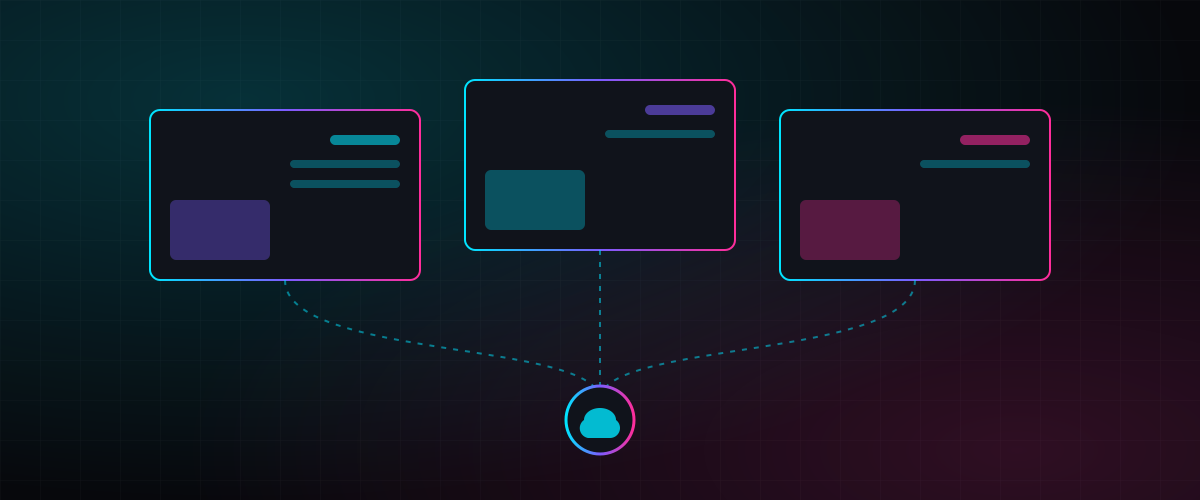
Nplay Beam is cloud digital signage and content management software. A central dashboard controls users, devices, media storage and schedules. Content includes HD video, images, audio, web links, satellite channels, widgets, HDMI feeds and 3D models. Campaigns are built from playlists with automated scheduling, so an Arabic morning loop can switch to an English and Arabic evening one at set times.
Screens can be split into regions, with a promotional corner, a text bar or a static image layered on top of video. You can manage a single screen or many as a group, play, pause or mute from anywhere, and push an unscheduled message instantly. If the internet drops, the player keeps showing the last synced content. Players include our own 4K set-top box, an 8K player and common smart-TV platforms, and video walls run in 2×2, 3×3 and 7×1 portrait formats.
For venues where it matters, an optional prayer-time mode pauses music and video at prayer times. Content is yours: Beam plays the bilingual artwork you supply, and we test it on a real screen with you.
A buyer's checklist for bilingual signage
| Requirement | Why it matters in the Gulf | What to ask the vendor |
|---|---|---|
| One dashboard for both languages | Every message exists twice | Can I schedule Arabic and English versions together? |
| Layered overlays and split screens | Offers, hours and banners change daily | Can a text bar or corner promotion sit on top of video? |
| Offline playback | Connections fail; screens must not go blank | What does the player show when the network drops? |
| Audio control | Retail and cafés use in-store music | Can the software control sound, not only video? |
| Prayer-time behaviour | Respect for customers and staff | Is there an optional mode, and can I set it per site? |
| Support and installation | Sites are in different cities | Who installs, and what does year-one support cover? |
What bilingual content looks like by venue
Retail. Offers and prices change weekly, so the loop should be built from reusable templates with live text rather than baked-in images. Keep staff training and announcements on a separate playlist from customer content, as our hypermarket deployment does.
Cafés and restaurants. Menus, promotions and ambience share a screen, often in a 2×2 or portrait wall. Café packages add a music layer that pauses when a video plays and resumes afterwards. Mix Arabic and English menu text deliberately: dish names in both scripts, descriptions in the language of the customer you most expect.
Healthcare and clinics. The content is calmer and editorial control matters more. The facility decides what patients see, in which language, and for how long.
Hotels, malls and offices. Lobby screens, wayfinding and event listings need clear hierarchy and large type. Beam can also display interactive systems such as a wayfinding application as content.
Schedules follow the calendar, not the other way round
The Gulf's business rhythm shifts across the year: trading hours, offers and mood change in the holy month, at national celebrations and in summer. A signage platform should treat these as ordinary campaigns. Build the seasonal playlist in advance, set its start and end dates, and let the schedule switch it on and off. Nobody should be editing screens at midnight on the eve of a holiday.
The same approach works for a digital signage GCC network that spans several cities. Stores in different emirates or different countries may share a master campaign and differ only in a local banner or an opening time. Group screens by site, publish the shared loop once, and add the local layer on top. That way a head office updates one playlist and each branch still looks like itself.
The same discipline applies to bilingual updates. Write the Arabic and English versions in one brief, approve them together, and schedule them together. A price that changes in one language and not the other is worse than no sign at all.
What the Jordan deployments taught us
Anyone shortlisting digital signage software UAE retailers already run will ask for references, so here are ours. Beam is a delivered product. A national hypermarket chain in Jordan uses it across 32 branches: we connected 32 Beam players, shared 10 GB of cloud media storage, and wired each branch's switches and amplifiers so that music radio follows the dashboard. Head office publishes offers, staff training and announcements from one place. An integrated healthcare hub in Amman runs four displays with 5 GB of storage, and a national memorial museum runs ten displays with three different display types. The stories are in our hypermarket case and clinic case.
These are Jordanian deployments. We have no installed signage network in the UAE, Qatar, Kuwait, Bahrain or Oman, and we say so. What carries over is method: decide centrally who can publish what, which is as true for digital signage Qatar chains as for Jordanian ones, separate customer content from staff content, include sound in scope from the start, and choose software that shows you which screen is offline before a customer does.
How a pilot works when we serve you remotely
We serve the GCC from Amman and Riyadh. A typical pilot starts on one site. We agree the screens, the players and the first playlists, prepare Arabic and English content with you, and ship players that connect to the cloud dashboard. On-site installation and commissioning are arranged with your team or a local integrator; we support the platform remotely. Beam's café and restaurant packages are built to be plug and play, and our ten-criteria guide lists the tests to run.
On commercial terms, ask every supplier to state per screen: the player, the software subscription, the storage allowance, who installs, and what support covers. With Beam, players are sold per unit and cloud software is an annual subscription per device with a storage allowance. We do not publish prices because the number of screens, storage and audio work change the answer. The delivery period quoted for chain proposals in Jordan is two to four weeks; for the Gulf we confirm it per project. For digital signage Qatar chains the method is identical, and for digital signage software UAE operators it is the same again; our pages for the UAE and Qatar give more detail.
Bilingual digital signage: frequently asked questions
Does Nplay have signage customers in the UAE or Qatar?
No. Our deployments are in Jordan. We serve the Gulf from Amman and Riyadh, with installation arranged with the client or a local integrator.
Can Beam run Arabic and English content?
Beam plays the bilingual content you supply and schedules it from one dashboard. We test Arabic artwork on a real screen with you before launch.
What happens if the internet drops?
The player keeps showing the last synced content until it reconnects, and the dashboard shows device status.
Is there a prayer-time mode?
Yes, as an optional mode that pauses music and video at prayer times, useful for cafés and similar venues.