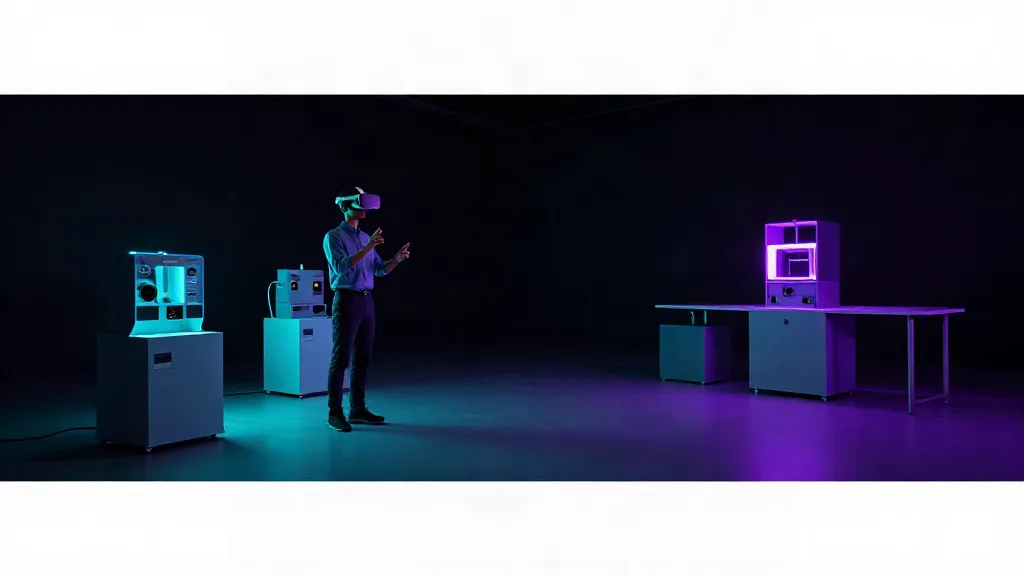
VR for wellbeing: a practical guide from Nplay. This article covers what matters about VR for wellbeing, from the first idea to delivery.
Table of contents
Most of what Nplay builds is meant to be experienced in public — a hologram at an event, an AI receptionist in a lobby, a digital twin on a showroom floor. Two of the concepts furthest along right now are quieter, built for a single person at a time: SAKINA Pod, a relaxation capsule, and Nplay VR for Hospitals, a concept exploring VR’s role in reducing pain and anxiety during medical procedures. Neither is in production yet. Together, though, they show something real about how Nplay approaches VR: the same underlying capability, aimed at very different human needs.

SAKINA Pod: Engineering Rest
SAKINA Pod is a sealed, single-person, climate-controlled VR relaxation capsule, currently in design development. The shell is black anodised aluminium with a smoked acrylic sliding door, and the interior air is actively managed through HEPA-filtered ventilation. A five-state light system — ready, opening, occupied, purging, fault — signals what the pod is doing at a glance, and the door lock carries four independent safety provisions so the person inside is never at risk of being unable to exit. As the brief that shaped it puts it: “Rest, engineered.”
SAKINA Pod is issued for design development only — dimensions and component selections stay indicative until the design is frozen with a fabricator. It is not yet available for purchase or deployment.
VR for Hospitals: The Science of Calm in Clinical Settings
Nplay VR for Hospitals is an early-stage concept and prototype, explored together with clinical partners. It is not a claimed medical device, and it carries no FDA or CE approval. What it is grounded in is real, published research. A 2024 meta-analysis in BMC Medicine, covering 92 trials and 7,133 patients, found VR reduced pain with a standardized mean difference of -0.78 overall — with the effect even stronger for children (-0.91) than adults (-0.66), and particularly strong for venepuncture (-0.99), childbirth (-0.99) and burn dressing changes (-0.8). A 2025 systematic review in the European Journal of Pain reached a similar conclusion, describing VR as safe and effective at reducing in-hospital anxiety and pain.
The mechanism is simple to describe, harder to engineer well: VR captures a patient’s attention fully enough that there is less of it left over for pain and fear. Nplay’s work here is about exploring how to design that experience responsibly, in partnership with the clinicians who understand the settings it would be used in.
One Underlying Capability, Many Applications
SAKINA Pod and VR for Hospitals sit at one end of what Nplay builds — experiences designed around a single person’s wellbeing. The same core capability in immersive VR, AI and spatial design shows up across Nplay’s full service line: AI receptionists and AI holograms (which share one conversational AI backend), VR training and simulation for industrial and safety-critical teams, digital twins and virtual showrooms for sales and planning, and the creative branding, web development, AI tools and digital marketing work that supports all of it.
A wellness capsule and a hospital waiting room are different problems from a retail showroom or a training floor — but the underlying skill of building VR and AI experiences people actually want to be inside of is the same one.
Built in Amman, Designed for the World
Nplay was founded in Amman, Jordan, in 2018, and that is still where this work happens — from the earliest hologram projects to concepts like SAKINA Pod and VR for Hospitals today. Both are still in development, not yet available to buy or deploy, but they represent the same design discipline behind everything else Nplay ships: real research, real engineering constraints, and no invented claims about where a concept stands.
Further reading: Virtual reality (Wikipedia)
Quick questions about VR for wellbeing
Who is VR for wellbeing for? Companies and institutions that want a clearer, faster experience for their customers and visitors.
How long does VR for wellbeing take? It depends on the size of the project and the content needed. We confirm the timeline after a short discovery call.
How do I start with VR for wellbeing? Contact the Nplay team in Amman or Riyadh and we will suggest a clear first step.
Does VR for wellbeing work in Arabic and English? Yes. We prepare the content in both languages from day one.


In short, VR for wellbeing works best when it starts from a clear goal. Nplay plans VR for wellbeing around your audience, your space and your budget.
Leave a Reply